
I've watched countless SaaS products die because founders built the wrong features first. After 25 years of shipping software and building vertical SaaS products at Dazlab.digital, I've learned one brutal truth: your first feature list will be 80% wrong. The trick is making sure that 20% you get right actually matters.
This article is part of our complete guide to SaaS MVP development.
Last month, we helped a real estate association cut their MVP scope from 47 features down to 6. They launched three months earlier and hit their first 100 paying users within weeks. Meanwhile, their competitor is still building their "complete" platform a year later with zero revenue.
Here's the approach we use at Dazlab.digital to scope MVPs that actually ship and generate revenue. No theoretical frameworks — just what works when you're trying to get software into customers' hands.
The Problem with Traditional MVP Scoping
Most SaaS product scoping starts with a massive wishlist. Product managers create feature matrices. Stakeholders add their pet requirements. Engineers estimate everything will take "just two more sprints." Six months later, you're still building and your runway is gone.
We see this pattern constantly in our consulting work. An HR tech startup we advised had mapped out 73 features for their applicant tracking system. They were convinced candidates needed AI-powered personality assessments, video interviews, and blockchain-verified credentials. What candidates actually wanted? A simple way to track their application status.
The traditional approach fails because it starts from the wrong question. Instead of asking "What features could we build?" you should ask "What's the smallest thing we can ship that solves one painful problem really well?" This shift changes everything about how you approach MVP feature definition.
Our Three-Layer Scoping Framework
At Dazlab.digital, we break MVP features into three distinct layers. This isn't just categorization — it's a forcing function that makes you defend every single feature choice.
Layer 1: Core Value Features (Maximum 3-5)
These are the features that directly solve your user's primary pain point. Without these, your product has no reason to exist. When we built billing software for creative agencies, our core value features were: creating invoices, tracking time, and sending payment reminders. That's it. Everything else could wait.
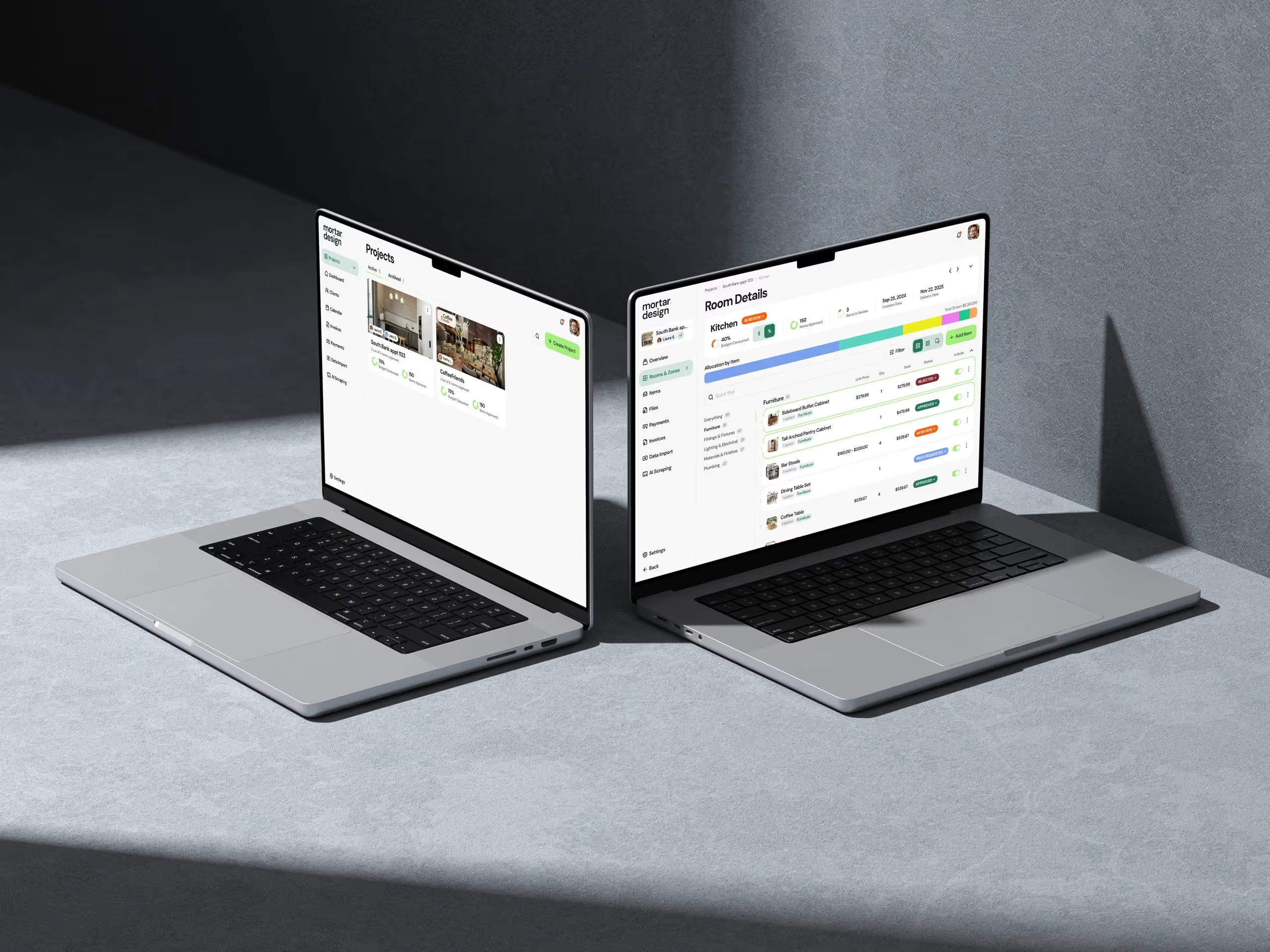
Here's how to identify core value features: If removing the feature means your target customer would rather use a spreadsheet, it's core. We learned this building project management software for interior designers. They told us they needed Gantt charts, resource allocation, and budget tracking. But when we dug deeper, their real pain was simply knowing which fabric samples had arrived for which client. One feature — sample tracking — became our entire MVP.
Layer 2: Trust Features (Maximum 2-3)
Trust features don't deliver core value but they're table stakes for your market. Users won't pay without them. For B2B SaaS, this usually means basic security, data export, and some form of admin controls. For consumer apps, it might be social login or payment processing.
The key insight about trust features: build the minimum viable version. When we launched our content management system for digital agencies, clients demanded "enterprise-grade security." Instead of building complex SAML integrations, we shipped with two-factor authentication and SOC 2 compliance. Nobody complained. They just wanted to check a box.
Don't confuse trust features with nice-to-haves. A trust feature is something that blocks the sale if missing. Everything else goes in Layer 3.
Layer 3: Delight Features (Maximum 1-2)
These features make users smile but aren't essential for launch. Maybe it's a slick onboarding animation or intelligent defaults that save time. Pick one or two maximum — just enough to show you care about user experience without derailing your timeline.
We added smart project templates to our agency billing software as a delight feature. It took two days to build but made demos ten times more compelling. The key is choosing delight features that are quick to implement but have outsized impact on perception.
The Reality Check Process
Once you've drafted your three layers, run them through our reality check process. This is where most teams discover they're still overbuilding.
Step 1: The Concierge Test
Could you deliver this value manually for your first 10 customers? If not, you're automating too early. When we built recruitment software for small HR teams, our "AI-powered candidate matching" started as me literally reading resumes and making recommendations over email. Only after validating the matching criteria did we build the algorithm.
This test forces brutal prioritization. That sophisticated workflow engine you think you need? Start with a simple linear process and see if anyone complains. The advanced reporting dashboard? Send weekly CSV exports first. You'll be surprised how often the manual version is good enough.
Step 2: The Demo Test
Mock up your MVP with just these features. Now demo it to five potential customers. Don't explain what's coming later — just show what you're planning to ship. If they're not ready to pay for this version alone, you've scoped wrong.
We failed this test spectacularly with our first attempt at real estate association software. Our demo showed member directories, event management, and dues collection. Prospects kept asking about MLS integration. Turns out that was the only feature that mattered — everything else was a distraction from their core need.
Step 3: The Engineering Test
Can your team build this in 8-12 weeks? If your MVP takes longer than three months, it's not minimal enough. This constraint forces hard decisions but prevents scope creep from killing your momentum.
Break each feature into its absolute simplest version. "User authentication" doesn't mean building your own auth system — it means implementing Auth0 in a day. "Payment processing" doesn't mean supporting every payment method — it means Stripe checkout for credit cards only. Every feature should have a "good enough" version that ships fast.
Common Scoping Mistakes We See
After helping dozens of teams scope their MVPs, certain patterns emerge. Here are the mistakes that kill most SaaS products before they launch.
Building for the Exception Cases
"But what if a user needs to..." is the most dangerous phrase in product scoping. We worked with an HR tech startup that spent two months building approval workflows for the 5% of companies with complex hierarchies. Meanwhile, 95% of their target market just wanted simple offer letter generation.
Build for your median user, not your edge cases. Those complex scenarios that keep you up at night? They're usually hypothetical. Ship your MVP and let real usage data tell you which edge cases actually matter.
Confusing Features with Benefits
"Advanced analytics dashboard" isn't a feature — it's a delivery mechanism. The actual feature is "knowing which content performs best" or "tracking project profitability." When you scope in terms of features instead of benefits, you overbuild every time.
We made this mistake building our CMS. We scoped "visual page builder" as a feature because competitors had one. What clients actually wanted was "publish content without calling a developer." A simple markdown editor with live preview solved that need in one-tenth the time.
Platform Thinking in an MVP
Your MVP is not a platform. Stop building abstraction layers, plugin systems, and API-first architectures. We've seen teams spend months on "scalable foundations" for products that never find product-market fit.
Hard-code more than you think you should. Build for one use case, not ten. When we created billing software for agencies, we hard-coded the invoice format instead of building a template system. Three years and 500 customers later, only two have asked for customization.
Our MVP Scoping Template in Action
Here's the exact template we use at Dazlab.digital for every new product. We've refined this through dozens of launches, from AI-native software to vertical SaaS products.
Section 1: Problem Definition
- What specific problem are we solving?
- For which specific type of user?
- How are they solving this today?
- What's the measurable pain of their current solution?
Section 2: Core Value Features (3-5 max)
- Feature name
- User benefit (one sentence)
- Success metric
- Simplest possible implementation
Section 3: Trust Features (2-3 max)
- Feature name
- Why it's required for this market
- Minimum acceptable version
- Can we use a third-party service?
Section 4: Delight Features (1-2 max)
- Feature name
- Implementation effort (days)
- Demo impact (high/medium/low)
- Can this wait for v2?
Section 5: Reality Checks
- Concierge test plan
- Demo script outline
- Engineering timeline
- What we're explicitly NOT building
Let me show you how this played out for a recent project. We built specialized software for interior design firms to manage client samples and sourcing. Here's our actual scoping document:
Problem: Interior designers waste 10+ hours per week tracking fabric samples across multiple client projects.
Core Value Features:
1. Sample inventory tracking - Know which samples are where
2. Client assignment - Link samples to specific projects
3. Status updates - Mark samples as ordered/received/returnedTrust Features:
1. Basic user accounts - Designers need separate logins
2. Data export - CSV download for peace of mindDelight Feature:
1. Photo capture - Snap photos of samples with automatic taggingNOT Building: Vendor catalogs, pricing integration, mood boards, client portals, mobile apps, invoicing
This scope took 7 weeks to build and landed paying customers in week 8. The features we didn't build? Six months later, customers still haven't asked for them.
The Post-Launch Reality
Here's what nobody tells you about MVP feature definition: your first users will immediately demand features you cut. This is good — it means they're engaged enough to have opinions. But don't panic and build everything they ask for.
We track feature requests religiously but only build when we see patterns. One user wanting Salesforce integration is feedback. Ten users willing to pay extra for it is a roadmap item. This discipline keeps your product focused while you search for product-market fit.
The real test of good MVP scoping isn't whether users ask for more features — they always will. It's whether your core features solve their problem well enough that they'll pay while waiting for the rest. If you've scoped correctly, the answer is yes.
After building dozens of vertical SaaS products at Dazlab.digital, from AI-native solutions to niche industry software, I've learned that the best MVPs feel almost embarrassingly simple to launch. You'll worry you're shipping too little. Your competitors will have more features. Your demo will feel bare compared to your vision.
Ship it anyway. Real users and real revenue beat perfect features every time. The market will tell you what to build next — but only if you give them something to react to first.
Want help scoping your SaaS MVP? We selectively partner with teams building vertical SaaS and AI-native products where our hands-on experience can make a real difference. Reach out to explore working together at Dazlab.digital.
Frequently Asked Questions
Frequently Asked Questions
What's the ideal timeline for building a SaaS MVP?
Based on our experience at Dazlab.digital, a properly scoped MVP should take 8-12 weeks to build. If your timeline extends beyond three months, you're likely overbuilding. We've found that constraints force better prioritization — teams that ship in under 12 weeks are more likely to find product-market fit because they're testing core assumptions faster.
How do you handle feature requests during MVP development?
Document every request but don't build them immediately. We track all feature requests but only act on patterns — when multiple users request the same functionality and indicate willingness to pay for it. During MVP development, stay focused on your original scope unless you discover your core value proposition is fundamentally wrong.
Should we build our own authentication system for our MVP?
No. This is one of the most common mistakes we see. Use Auth0, Firebase Auth, or similar services for your MVP. We've built dozens of SaaS products and only needed custom authentication for very specific compliance requirements years after launch. Third-party auth takes days to implement versus weeks for custom solutions.
What's the minimum number of features needed for a viable SaaS MVP?
We recommend 3-5 core value features, 2-3 trust features, and 1-2 delight features maximum. In our experience, successful MVPs often launch with just 6-10 total features. The key is ensuring your core features completely solve one specific problem rather than partially solving many problems.
How do you know when to stop cutting features from your MVP scope?
Run the demo test: mock up your MVP and show it to five potential customers without explaining future features. If they're ready to pay for just what you're showing, you've found the right balance. If they all ask for the same missing feature, consider adding it. If they ask for different features, you're likely at the right scope.
Related Reading

Dazlab is a Product Studio_
Our products come first. Consulting comes second. Whichever path you take, you’ll see how a small team can deliver outsized results.