Let me save you some time: if you're looking for a simple price list, you won't find it. After 25 years of building software and running Dazlab.digital, I've learned that anyone giving you a flat rate without understanding your business is either lying or doesn't know what they're doing.
This article is part of our complete guide to hiring development studios.

But I can tell you what drives costs, what you should expect to pay, and most importantly — how to know if you're getting ripped off. Because whether you're an interior design firm looking to automate workflows or an HR tech startup building your MVP, understanding development studio pricing is the difference between launching something great and burning through budget on vaporware.
The Reality of Development Studio Pricing in 2026
Here's what nobody tells you: software development studio cost has gotten both cheaper and more expensive. Sounds contradictory? Let me explain.
The tools we use today — AI copilots, no-code platforms, automated testing — mean we can build certain things 10x faster than five years ago. A basic CRUD app that took three months in 2020? We can ship that in three weeks now. But here's the catch: nobody needs basic CRUD apps anymore. The bar for what constitutes "table stakes" has risen dramatically.

I've seen studios quote anywhere from $25,000 for a simple MVP to $2 million for enterprise platforms. But those numbers mean nothing without context. It's like asking how much a car costs — are we talking about a used Honda or a custom Ferrari?
What Actually Drives Software Development Studio Cost
After building everything from real estate SaaS to HR tech platforms, I've found costs come down to five main factors. And no, "how many screens" isn't one of them.

1. Problem Complexity vs. Solution Sophistication
The biggest driver of cost isn't the number of features — it's how hard those features are to get right. Building a billing system that just tracks invoices? That's straightforward. Building one that handles complex approval workflows, integrates with QuickBooks, and prevents payment disputes before they happen? That's a different beast entirely.
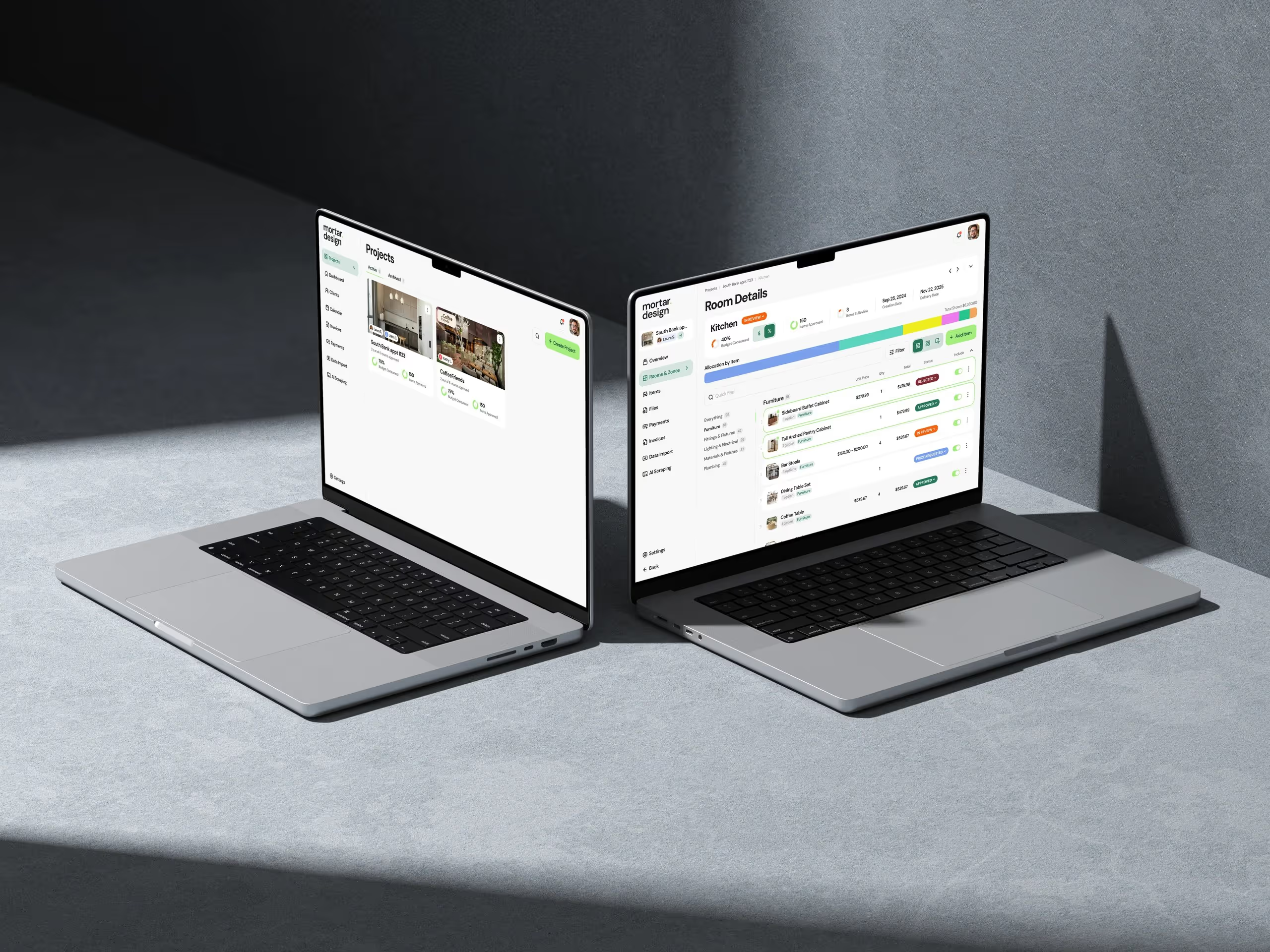
We recently built a project management tool for interior designers. The basic version — track projects, assign tasks, share files — could've been done for $40,000. But the version that actually solved their problems? The one that automatically pulled product specs from vendor catalogs, calculated lead times, and flagged budget overruns before they happened? That was a $200,000 build. Same "category" of software, 5x the price, but 50x the value.
2. AI-Native vs. AI-Sprinkled
Everyone wants AI in their product now. But there's a massive cost difference between sprinkling some ChatGPT calls into your app and building truly AI-native software. The former might add $10,000-20,000 to your budget. The latter? You're looking at significant infrastructure costs, model training, and ongoing optimization.
We built an applicant tracking system that uses AI to match candidates to roles. Not just keyword matching — actual understanding of skills, experience, and culture fit. That AI component alone was a $75,000 investment. But for our client, it cut their time-to-hire by 60%. Sometimes the expensive solution is the cheap solution.
3. Integration Depth
Modern software doesn't exist in isolation. Your users expect it to play nicely with their existing tools. And every integration adds complexity — and cost.
Simple API integrations (think Zapier-level connections) might add $5,000-10,000 per integration. Deep, bidirectional sync with complex systems like Salesforce or custom ERPs? Budget $25,000-50,000 per integration. And that's assuming their APIs actually work as documented, which they rarely do.
"The difference between a $50,000 project and a $500,000 project often comes down to one question: how deeply does this need to integrate with existing systems?"
4. Performance and Scale Requirements
Building for 100 users is fundamentally different from building for 100,000 users. Not just technically — the entire approach changes. Error handling becomes critical. Performance optimization isn't optional. Security goes from "important" to "existential."
I've seen too many companies build for their current scale and then pay 3x to rebuild when they grow. Smart money plans for 10x growth from day one. Yes, it costs more upfront — typically 30-50% more. But it's still cheaper than rebuilding in 18 months.
5. Post-Launch Reality
Here's what most studios won't tell you: launch is maybe 30% of the total cost. The real expenses come after. Bug fixes, user feedback implementation, scaling issues, security patches, new feature requests — they all add up.
Smart studios (like us at Dazlab.digital) price this into their contracts. We typically recommend budgeting 20-30% of initial development cost annually for maintenance and improvements. Studios that quote suspiciously low prices? They're either planning to disappear after launch or hit you with massive change orders.
Real Numbers: What Studios Actually Charge
Enough theory. Let's talk actual numbers. Based on what we charge and what I see in the market, here's what you can expect to pay in 2026.
Freelancers and Small Studios (1-5 people)
Hourly rates: $75-200/hour
Typical project range: $25,000-150,000
Sweet spot: Simple SaaS MVPs, workflow automation tools, basic mobile apps
These folks can be great for straightforward projects. We started here at Dazlab. But be careful — the cheapest option often becomes the most expensive when you factor in delays, rework, and technical debt. I've rescued too many projects from $50/hour developers who created $500,000 messes.
Mid-Size Studios (10-50 people)
Hourly rates: $150-350/hour
Typical project range: $100,000-1,000,000
Sweet spot: Vertical SaaS products, enterprise integrations, complex B2B platforms
This is where Dazlab.digital operates. You're paying for experience, process, and the ability to handle complex requirements. We can build your HR tech platform while simultaneously designing your go-to-market strategy. More expensive? Yes. More likely to actually succeed? Absolutely.
Large Agencies and Enterprise Studios (50+ people)
Hourly rates: $250-500/hour
Typical project range: $500,000-5,000,000+
Sweet spot: Fortune 500 digital transformation, massive consumer apps
Unless you're a large enterprise or VC-backed startup, you probably don't need these folks. They're great at what they do, but you're paying for overhead, process, and brand name. For most vertical SaaS products, you'll get better results from a specialized studio.
How to Evaluate Development Studio Pricing
Getting quotes from studios? Here's how to cut through the BS and understand what you're really paying for.

Red Flags in Pricing
Run away if you see:
- Fixed prices without discovery phases
- Hourly rates under $100 for complex work
- No mention of post-launch support
- Promises that sound too good ("We'll build your Uber for X in 6 weeks!")
- Unwillingness to show similar past work
I once had a client come to us after another studio quoted them $30,000 for a "simple" real estate platform. Six months and $150,000 later, they had nothing to show for it. The studio kept finding "unexpected complexity" — complexity that any experienced team would have spotted in week one.
What to Look For
Good studios will:
- Insist on a paid discovery phase
- Break down costs by component
- Include buffer for unknowns
- Talk about maintenance from day one
- Show you similar projects with actual outcomes
When we quote a project at Dazlab.digital, we include three scenarios: MVP, recommended build, and dream build. Each with clear trade-offs. Because the cheapest option isn't always the best value, and the most expensive isn't always necessary.
The Discovery Phase Investment
Any studio worth their salt will insist on a discovery phase. Yes, it costs money — typically $10,000-50,000. Yes, it feels like paying for nothing. But it's the best investment you'll make.
During discovery, we dig into your actual business problems, not just your feature list. We map out technical architecture, identify integration challenges, and spot the gotchas that derail projects. More importantly, we figure out if we're even the right fit. Because taking your money for a project we can't nail is bad for everyone.
Getting the Most Value from Your Development Budget
Here's what I tell every potential client: the goal isn't to spend less money. It's to get more value per dollar spent. Sometimes that means spending more upfront to avoid massive costs later.
Start with the Problem, Not the Solution
The most expensive projects I've seen are ones where clients come with a fully-specified solution that solves the wrong problem. You don't need a "app like Uber but for dog walking." You need to solve a specific problem for dog owners or walkers. Let the solution emerge from deep problem understanding.
We built a recruiting platform that started as a request for "LinkedIn for our industry." After digging in, we discovered the real problem was candidates ghosting after initial interest. The solution? Not a social network, but an engagement tracking system that reduced ghosting by 70%. Same budget, completely different (and better) outcome.
Phase Strategically
You don't need every feature on day one. In fact, you shouldn't want every feature on day one. The best products evolve based on real user feedback, not conference room assumptions.
We typically recommend launching with 30-40% of the "dream feature list." Get it in users' hands, learn what actually matters, then invest in the right directions. This approach typically saves 40-50% over the "build everything upfront" method. Plus, you start generating revenue sooner.
Consider the Total Cost of Ownership
A studio that charges 20% less but delivers buggy code will cost you more in the long run. Factor in:
- Maintenance and hosting costs
- Time to market (opportunity cost)
- Technical debt (future rebuild costs)
- Team handoff (can your team maintain it?)
- Scalability (will it handle growth?)
We've taken over projects where clients "saved" $100,000 on initial development but spent $300,000 fixing problems in year one. That's not savings — that's expensive borrowing.
Making the Decision: When to Hire a Development Studio
Not every project needs a development studio. Sometimes you need a freelancer, sometimes an internal team, sometimes a no-code solution. Here's how to know when studio pricing makes sense.
Hire a Studio When:
- You're building core business software (not just internal tools)
- Speed to market matters more than absolute lowest cost
- You need expertise you don't have internally
- The project requires multiple disciplines (design, development, strategy)
- You're entering unknown technical territory
- Failure would significantly impact your business
We work with a lot of vertical SaaS founders who have deep industry expertise but limited technical knowledge. For them, a studio isn't an expense — it's leverage. They focus on what they know (the industry problem) while we handle what we know (building great software).
Consider Alternatives When:
- You have strong internal technical leadership
- The project is well-understood with minimal unknowns
- You're building internal tools with flexible deadlines
- Budget is extremely constrained with no flexibility
- You need ongoing development indefinitely
Sometimes the right answer is to hire a CTO and build internally. Sometimes it's to use no-code tools for v1. The key is being honest about your constraints and capabilities.
The Bottom Line on Development Studio Pricing
After 25 years in this business, here's what I know: good software is expensive. Bad software is more expensive. The cheapest option is rarely the best value. And the most expensive option is often overkill.

- $25,000-75,000 for basic MVPs
- $75,000-250,000 for solid vertical SaaS products
- $250,000-1,000,000 for complex enterprise platforms
- 20-30% annually for maintenance and improvements
But more important than the numbers is finding a studio that gets your business, shares your values, and has successfully built similar products. Because at the end of the day, you're not buying code — you're buying outcomes.
At Dazlab.digital, we specialize in vertical SaaS for niche industries. We're not the cheapest option, and we're not trying to be. But if you're serious about building software that actually solves problems and drives revenue, let's talk. Because whether you work with us or someone else, you deserve a partner who tells you the truth about what things cost and why.
Ready to get specific about your project? Reach out and we'll give you a real assessment — no BS, no surprise costs, just straight talk about what it takes to build great software in 2026.
Frequently Asked Questions
What's the average cost to hire a software development studio in 2026?
Based on market rates and our experience at Dazlab.digital, expect to pay $25,000-75,000 for basic MVPs, $75,000-250,000 for solid vertical SaaS products, and $250,000-1,000,000 for complex enterprise platforms. Additionally, budget 20-30% of initial development cost annually for maintenance and improvements.
Why do some development studios charge $75/hour while others charge $350/hour?
The price difference reflects experience, team size, and capability. Cheaper studios often create technical debt that costs more to fix later. Mid-range studios like Dazlab.digital ($150-350/hour) balance expertise with value, while enterprise studios ($250-500/hour) include overhead for massive scale projects that most businesses don't need.
Is it worth paying for a discovery phase before development?
Yes. A discovery phase ($10,000-50,000) helps identify technical challenges, integration issues, and validates that you're solving the right problem. It prevents costly mistakes and pivots during development. Any reputable studio will insist on discovery because building the wrong solution perfectly is more expensive than taking time to get it right.
How can I tell if a development studio's pricing is reasonable?
Look for studios that break down costs by component, include post-launch support, and show similar past work with real outcomes. Red flags include fixed prices without discovery, rates under $100/hour for complex work, and promises that sound too good to be true. Good studios provide multiple scenarios with clear trade-offs.
Should I hire a development studio or build an internal team?
Hire a studio when you're building core business software, need speed to market, lack technical expertise, or need multiple disciplines. Build internally when you have strong technical leadership, well-understood requirements, and need ongoing development indefinitely. Studios provide leverage for vertical SaaS founders who want to focus on industry problems while experts handle the technical build.
Related Reading


Dazlab is a Product Studio_
Our products come first. Consulting comes second. Whichever path you take, you’ll see how a small team can deliver outsized results.