
After 25 years of building software and launching over 50 SaaS products, I've seen every possible way to blow an MVP budget. I've also learned exactly where to spend money and where to save it.
This article is part of our complete guide to SaaS MVP development.
Most MVP budget calculators give you fantasy numbers. They assume perfect execution, no scope creep, and developers who work for peanuts. That's not how the real world works. This guide breaks down actual costs based on real projects we've built at Dazlab.digital.
Here's the truth: your SaaS MVP will cost between $25,000 and $250,000. That's a massive range, and I'll show you exactly what drives those numbers up or down. More importantly, I'll help you figure out where your specific product falls on that spectrum.
The Real Cost Components of a SaaS MVP in 2026
Let's start with what actually goes into an MVP budget. Forget the generic "development costs" line item you see everywhere. Real MVPs have seven distinct cost centers, and missing any of them will torpedo your launch.
Core Development typically eats 40-50% of your budget. This includes your backend architecture, frontend interface, and the actual features that make your product useful. For a basic B2B SaaS with 3-4 core features, you're looking at $30,000-60,000 minimum. That assumes you're building something straightforward like a project management tool or simple CRM.

Then there's Design and UX. I've watched too many technical founders skip this, thinking they can slap Bootstrap on their app and users won't care. They're wrong. Good design isn't about making things pretty—it's about making your product actually usable. Budget 15-25% for proper UX research, interface design, and user testing. That's $10,000-25,000 for most MVPs.
The Hidden Costs That Kill MVP Budgets
Now let's talk about the costs nobody mentions until it's too late. These are the budget killers that turn a $50,000 project into a $150,000 nightmare.
Third-party integrations are the biggest culprit. Every SaaS needs to play nice with other tools. Payment processing alone can eat 2-3 weeks of development time once you factor in subscription management, invoicing, and edge cases. Each major integration (Salesforce, Slack, Google Workspace) adds $5,000-10,000 to your budget. We built a recruiting platform last year that needed to sync with 5 different HRIS systems—that integration work alone cost more than the core product features.
Security and compliance is another black hole. If you're in healthcare, finance, or dealing with any sensitive data, add 30-40% to your base development costs. HIPAA compliance isn't just checking boxes—it's rearchitecting your entire data flow, implementing audit logs, and building features you'll never advertise but absolutely need. We spent $45,000 on security and compliance for a healthcare SaaS that would have been a $100,000 build otherwise.
Then there's the post-launch reality. Your MVP isn't done when you ship v1. You need budget for the first 3-6 months of iterations based on real user feedback. Plan for another 25-30% of your initial development cost for these critical early updates. Skip this buffer and you'll launch a product that users abandon after the first week.
Real MVP Examples and Their Actual Costs
Let me share some real numbers from recent projects. These aren't theoretical—they're actual invoices from MVPs we've built at Dazlab.digital.

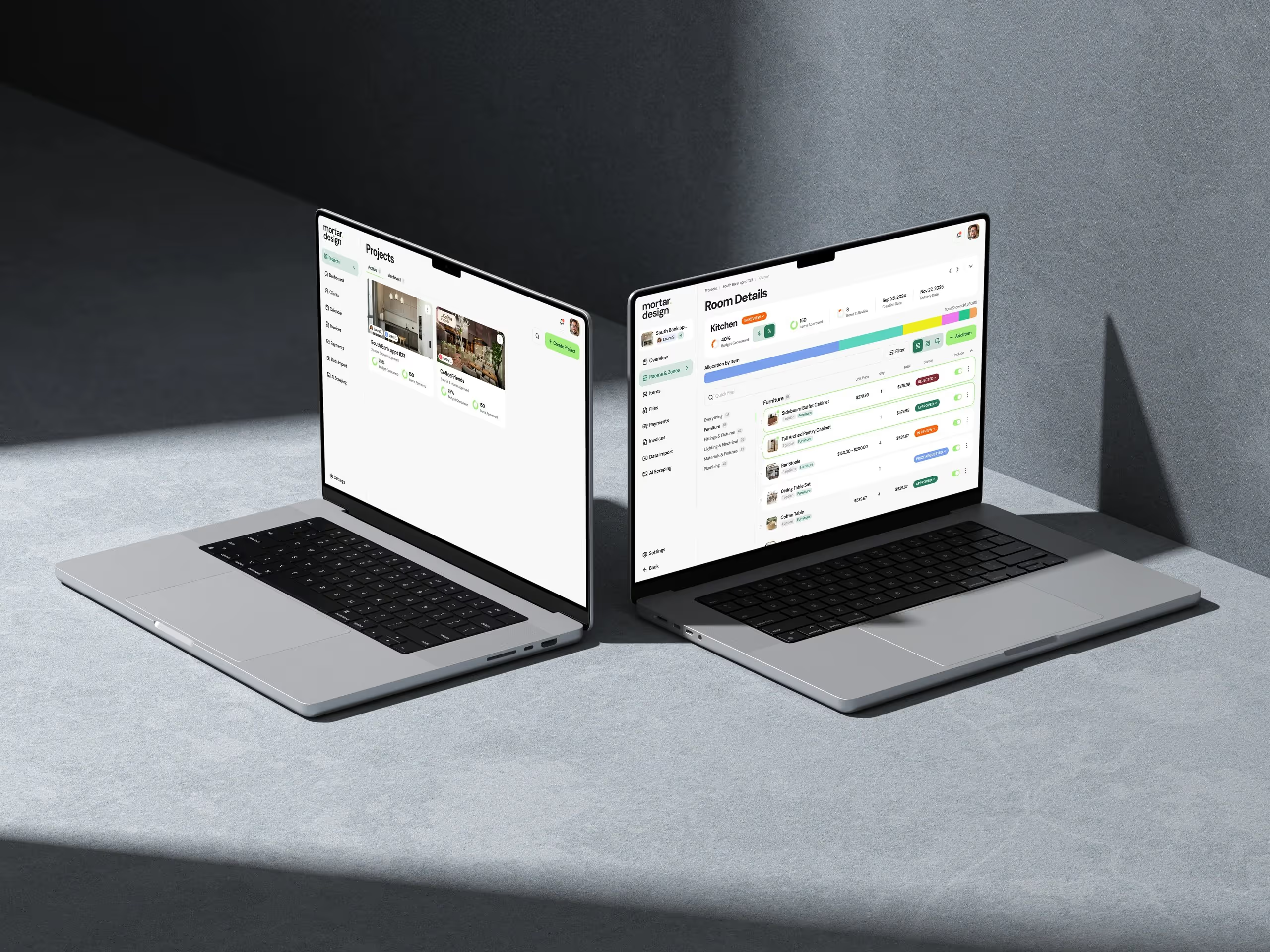
Interior Design Project Management Tool: Total cost: $85,000. This included custom mood board creation, client collaboration features, and vendor management. The killer feature was AI-powered furniture matching, which alone cost $15,000 to implement properly. We spent another $12,000 on Stripe integration for designer billing and client invoicing. The interesting part? We originally quoted $65,000, but the client needed QuickBooks integration halfway through, adding another $20,000 to handle all the accounting edge cases.
HR Applicant Tracking System: Total cost: $125,000. Sounds high for an ATS, right? But this wasn't another generic resume collector. We built custom video screening workflows, automated skill assessments, and deep integration with Microsoft Teams for interview scheduling. The compliance requirements alone—GDPR, CCPA, and various state privacy laws—added $35,000 to the budget. The AI-powered candidate matching system took 6 weeks to get right and cost $25,000 by itself.
Real Estate Association Member Portal: Total cost: $45,000. This was on the simpler end—member directory, event management, and dues collection. But even "simple" gets complex fast. The payment processing for different membership tiers, family plans, and corporate memberships turned into a 3-week project. We also had to build custom reporting for their board meetings, which wasn't in the original scope but became critical for launch.
"The difference between a $50k MVP and a $150k MVP isn't feature count—it's how deep those features need to go to actually solve the problem."
Building Your SaaS MVP Budget Calculator
Now let's build your actual budget. I'm going to walk you through the exact process we use at Dazlab.digital when scoping new projects. This isn't some generic formula—it's based on hundreds of real builds.
Start with your core feature set. List every single thing your MVP needs to do. Not what would be nice—what's absolutely essential for your first paying customer. Each feature has a complexity multiplier:
Simple features (user profiles, basic CRUD operations): $2,000-5,000 each
Medium features (workflow automation, basic reporting): $5,000-12,000 each
Complex features (AI/ML integration, real-time collaboration): $15,000-30,000 each
Next, add your integration tax. Every external system you touch adds complexity. Payment processing: add $8,000-15,000. Email/SMS notifications: add $3,000-5,000. CRM sync: add $10,000-20,000. These numbers assume you're building it right, not just making a basic API call and hoping for the best.
Don't forget your platform multiplier. Building for web only? That's your base cost. Need iOS and Android apps too? Multiply by 2.5x (not 3x—there's some shared backend work). Building a Chrome extension or Slack app? Add 30% to your base.
Here's the formula we actually use:
Base Feature Cost + Integration Costs + (Base × Platform Multiplier) + 25% Buffer = Real MVP Budget
Where to Spend and Where to Save
After building dozens of MVPs, I've learned exactly where you can cut corners and where you absolutely cannot. This knowledge will save you from expensive mistakes that kill products before they launch.

Smart places to save: Admin interfaces can be basic initially (your team can handle rough edges), reporting can start simple (export to CSV works fine), and visual polish can come in v2 (if the product solves a real problem). We launched a successful real estate SaaS with a bare-bones admin panel. Six months and 50 customers later, we invested in making it beautiful.
The biggest money-saver? Aggressive scope cutting. That feature you think is critical? Test with customers first. We've built entire systems that users never touched because we assumed we knew what they needed. Now we prototype everything in Figma first and get 10 potential customers to review it before writing a line of code.
The 2026 Reality Check: AI, Compliance, and Competition
Building an MVP in 2026 is fundamentally different than even two years ago. Three factors are driving costs up, and you need to account for all of them.
First, AI is no longer optional. Users expect intelligent features as table stakes. Not gimmicky chatbots—actual AI that makes their job easier. We're building AI-powered matching into every HR tool, automated insights into every analytics platform, and smart suggestions into every workflow tool. Budget $15,000-30,000 minimum for meaningful AI integration, even for an MVP.
Second, privacy regulations keep multiplying. GDPR was just the beginning. Now you've got CCPA, CPRA, Virginia's law, Colorado's law, and more coming. Building compliant from day one adds 20-30% to your development cost, but retrofitting compliance later costs 3x more. We just spent four months retrofitting privacy controls into a client's app—it would have taken three weeks if we'd built it correctly initially.
Third, user expectations are through the roof. Your competition isn't other startups—it's Notion, Slack, and every other polished SaaS users touch daily. Your MVP needs to feel professional from day one. That means real-time sync, mobile responsiveness, dark mode, keyboard shortcuts, and all the other "little" things that aren't little anymore.
Making Your MVP Budget Work
Here's my advice after burning through millions in MVP development: start with a realistic budget, then add 40%. I know that sounds pessimistic, but it's based on hard data. Of the last 50 MVPs we've built, exactly three came in under the original budget. The rest hit unexpected complexity, scope additions, or integration nightmares.
The successful MVPs all had three things in common: clear scope definition before development started, a dedicated product owner who could make fast decisions, and a willingness to cut features rather than quality. They also all launched with less than they wanted but more than users expected.
Remember, your MVP budget isn't just about getting to launch—it's about building something that can grow. Cutting too deep leaves you with a prototype that needs a complete rebuild. Overspending on unnecessary features burns runway you need for customer acquisition. The sweet spot is building exactly what your first 10 customers need to succeed, with a foundation that can scale to 1,000.
Want help figuring out your specific MVP budget? We've built a detailed calculator based on these real-world costs at Dazlab.digital. Or better yet, let's talk about your product idea and I'll give you a realistic number based on what we've actually built. After 25 years and 50+ launches, I can usually nail an MVP budget within 10% on the first call.
Frequently Asked Questions
What's the average cost of a SaaS MVP in 2026?
Based on our experience building 50+ products at Dazlab.digital, SaaS MVPs typically cost between $25,000 and $250,000. Most B2B SaaS MVPs with 3-4 core features land in the $75,000-$125,000 range. The wide variance depends on complexity, integrations needed, compliance requirements, and whether you need mobile apps alongside your web platform.
What hidden costs should I budget for in my SaaS MVP?
The biggest hidden costs are third-party integrations ($5,000-$10,000 each for major platforms), security and compliance (adds 30-40% for regulated industries), and post-launch iterations (budget another 25-30% of initial development cost). Infrastructure and DevOps setup typically adds $8,000-$15,000 that many founders forget to include.
How can I reduce my MVP development costs without sacrificing quality?
Focus your cuts on admin interfaces, advanced reporting, and visual polish—these can be improved after launch. Never compromise on authentication/security, payment processing, or core workflow automation. Aggressive scope cutting through customer validation can save the most money. Prototype everything in Figma first and get 10 potential customers to review before coding.
Do I really need AI features in my 2026 MVP?
Yes, meaningful AI integration is now table stakes for most SaaS products. Users expect intelligent features that actually save them time, not just chatbots. Budget $15,000-$30,000 minimum for AI features like smart matching, automated insights, or intelligent suggestions. Building without AI in 2026 puts you at a significant competitive disadvantage.
How accurate are these MVP cost estimates?
These numbers come from actual invoices of MVPs we've built at Dazlab.digital, not theoretical calculations. However, every project is unique. Of our last 50 MVPs, only three came in under original budget due to unexpected complexity or scope additions. That's why we recommend adding a 40% buffer to your initial estimate for a realistic budget.
Related Reading

Dazlab is a Product Studio_
Our products come first. Consulting comes second. Whichever path you take, you’ll see how a small team can deliver outsized results.