
I've shipped software for 25 years. Built products that failed spectacularly. Built others that found their groove. And after all that time in the trenches, I've learned one thing: your tech stack choices can make or break your MVP.
This article is part of our complete guide to SaaS MVP development.

First-time founders get this wrong constantly. They chase the newest framework. They over-engineer from day one. They build for scale before they have a single paying customer. I've made these mistakes myself — burned months on "perfect" architecture while competitors shipped and signed customers.
Here's what I tell founders who come to us at Dazlab.digital: your MVP tech stack should optimize for one thing above all else — speed to market. Everything else is negotiable.
Why Your SaaS Technology Choices Matter More Than Ever
The SaaS landscape in 2026 looks nothing like it did five years ago. AI isn't just a buzzword anymore — it's table stakes. Your customers expect intelligent features baked in from day one. They expect instant responses, personalized experiences, and software that actually understands their workflow.
But here's the kicker: they also expect all this at indie SaaS prices. The days of charging premium prices just because you have "AI-powered" in your tagline are over. Every competitor has AI now. What matters is execution speed and solving real problems.
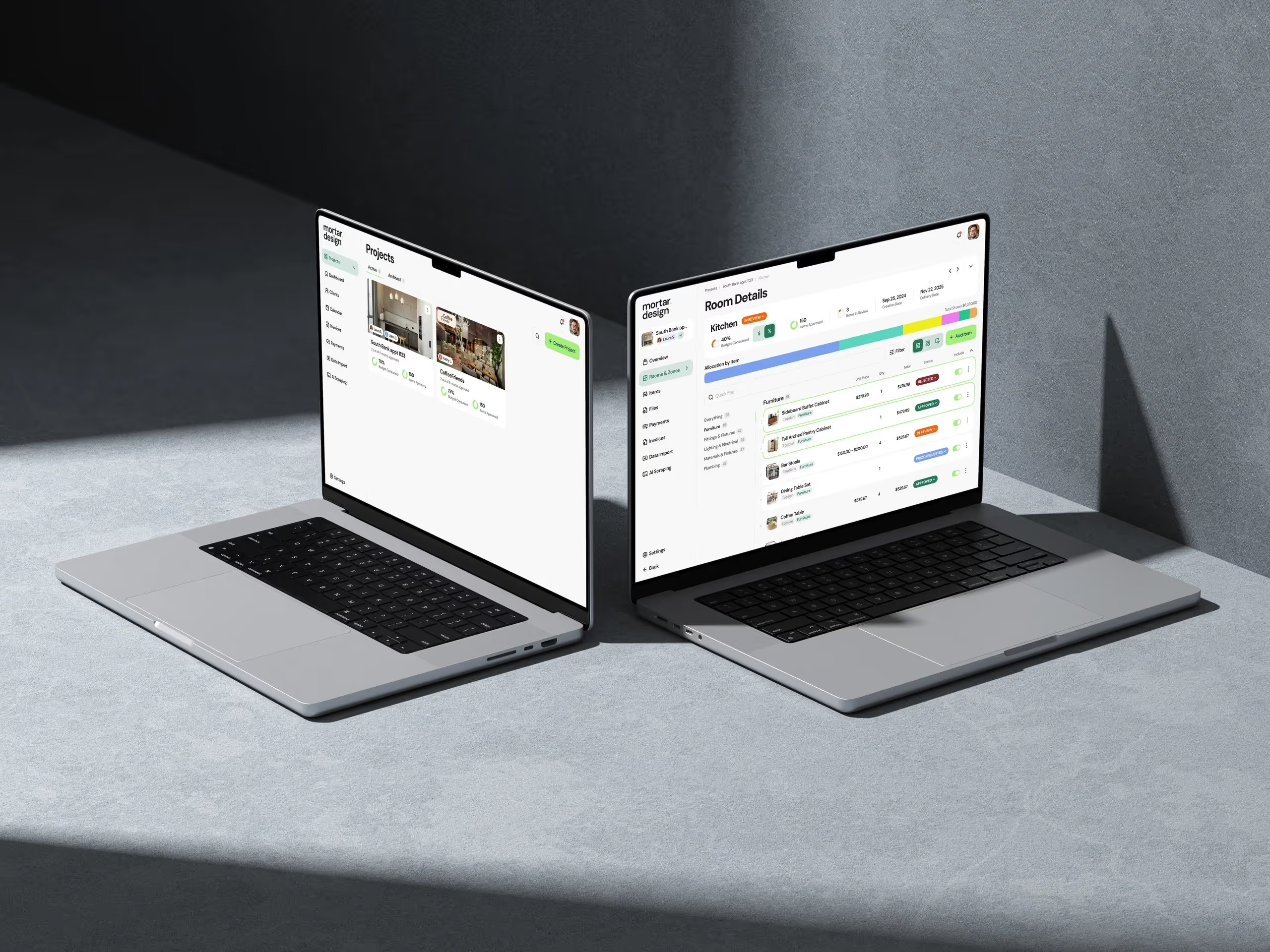
We learned this the hard way building TaliCMS. Interior designers didn't care about our fancy tech stack. They cared that we could ship features fast enough to keep up with their evolving needs. They cared that we understood their specific workflow challenges — not that we used the latest JavaScript framework.
Your tech stack should be boring enough to let you focus on what actually matters: understanding your customers and solving their problems better than anyone else.
The Core Stack: What You Actually Need
After building multiple SaaS products, here's the core stack I recommend for 90% of MVPs launching in 2026. It's not sexy. It's not cutting-edge. But it works, and more importantly, it ships.
Backend: Node.js + PostgreSQL

PostgreSQL remains the workhorse database. It handles everything from simple CRUD to complex analytics. The JSON support means you can start semi-structured and add schema as you learn what data actually matters. We've pushed Postgres to handle millions of records without breaking a sweat — you won't outgrow it anytime soon.
Skip the microservices architecture. I don't care what the conference talks say. Start with a monolith. We built our first three products as monoliths and only broke them apart when specific performance bottlenecks demanded it. By then, we actually understood our domain boundaries because we had real usage patterns to analyze.
Frontend: React + Next.js
React isn't the new hotness anymore, and that's exactly why you should use it. The ecosystem has matured. The rough edges are smoothed out. When you hit a problem at 2 AM, Stack Overflow has answers. When you need to hire, every frontend developer knows React.
Next.js gives you the best of both worlds — server-side rendering for SEO and performance, client-side interactivity where it matters. The App Router might feel like overkill initially, but it forces good patterns that pay dividends as your codebase grows.
For styling, Tailwind CSS remains king for MVPs. Yes, your HTML gets verbose. But you ship features in hours instead of days. You don't waste time naming CSS classes or dealing with specificity wars. Every developer on your team can jump into any component and understand the styling immediately.
Infrastructure: The Boring Choices That Work
Host on Vercel for your frontend and Railway or Render for your backend. Not because they're perfect, but because they handle the ops burden while you focus on building. We've tried the "save money with bare metal" approach. Unless you're processing massive data volumes, the time you save is worth 10x the hosting costs.
For file storage, use AWS S3 or Cloudflare R2. For email, Resend or Postmark. For payments, Stripe — don't even think about rolling your own billing. These are solved problems. Use boring solutions and move on to the interesting parts of your product.
The AI Layer: Where Things Get Interesting
Here's where 2026 diverges from previous years. Every SaaS MVP needs an AI strategy from day one. Not because it's trendy, but because your users expect intelligence baked into their workflows.

Start simple. Use OpenAI's API or Claude for general intelligence tasks. Don't try to fine-tune your own models yet — that's a distraction at the MVP stage. Focus on finding the 2-3 places where AI genuinely improves your user's workflow, not just adding chat interfaces everywhere.
We learned this building AI features for recruiters. They didn't want another chatbot. They wanted AI that could scan resumes and match candidates in seconds, not hours. That's a specific, valuable use case that justifies the AI integration.
For vector search and embeddings, Pinecone or Weaviate work well. But honestly? For most MVPs, PostgreSQL with pgvector gets you 80% of the way there. Start there, migrate later if needed.
The Data Pipeline Reality
Every founder thinks they need real-time everything. They don't. Most SaaS workflows are perfectly fine with "near real-time" — updates every few minutes instead of milliseconds. This dramatically simplifies your architecture.
Use simple cron jobs or background queues (Bull for Node.js works great) for most data processing. Save the complex event streaming for when you actually have customers complaining about latency. We've built successful products serving thousands of users with nothing fancier than scheduled jobs running every 5 minutes.
Security: The Non-Negotiables
Security isn't where you cut corners, even for an MVP. But you also don't need to build Fort Knox. Focus on the fundamentals that actually matter.
Use Auth0, Clerk, or Supabase Auth for authentication. Rolling your own auth in 2026 is malpractice. These services handle password resets, two-factor authentication, social logins, and all the edge cases that will bite you later.
Always use HTTPS (your hosting provider should handle this automatically). Store sensitive data encrypted at rest. Use environment variables for secrets. Run automated security scans as part of your CI/CD pipeline. These aren't optional — they're table stakes.
For compliance, don't overthink it at the MVP stage unless you're in a regulated industry. Add a privacy policy, terms of service, and basic GDPR compliance (cookie notices, data export). You can layer on SOC 2 and other certifications once you have enterprise customers asking for them.
The Testing Reality Check
Perfect test coverage is a luxury you can't afford at the MVP stage. But zero tests will burn you the moment you start scaling. Find the middle ground.
Write integration tests for your critical user paths — signup, payment, core feature usage. Skip unit tests for everything except complex business logic. Use Playwright or Cypress for end-to-end tests of your most important flows.
We aim for about 40-50% test coverage on MVPs. It's enough to catch the breaking changes that would anger customers, but not so much that we're writing tests for tests' sake. You can always add more tests once you validate the feature with real users.
Monitoring: What Actually Matters
Set up basic monitoring from day one. Sentry for error tracking, Vercel Analytics or Plausible for user analytics, and Betterstack or UptimeRobot for uptime monitoring. That's it. You don't need a full observability stack for an MVP.
The key is setting up alerts for what actually matters: payment failures, signup errors, and your core feature breaking. Everything else is noise at this stage. We've seen founders spend days configuring Datadog dashboards for products with zero users. Don't be that founder.
The Vertical SaaS Considerations
Building vertical SaaS adds unique constraints to your tech choices. Your users in specific industries often have quirky requirements that horizontal SaaS can ignore.
Real estate associations need specific MLS integrations. HR tech needs to handle sensitive employee data with extra care. Interior designers need high-resolution image handling that would crush a typical B2B SaaS. These aren't afterthoughts — they're core to your value proposition.
Plan for these from day one. If you're building for interior designers, your image pipeline better be rock solid. If you're in HR tech, your data privacy architecture needs to be bulletproof. These industry-specific requirements should influence your initial tech stack choices, not force expensive rewrites later.
We learned this building products across different verticals. Each industry has its own "table stakes" features that seem bizarre to outsiders but are absolutely critical to users. Your tech stack needs to be flexible enough to accommodate these without major surgery.
Making the Decision: A Framework
Here's my framework for making SaaS technology choices as a first-time founder:
First, optimize for shipping speed. Can you go from idea to deployed feature in hours, not weeks? If not, your stack is too complex. We measure our stack choices by "time to first feature" — how quickly can a new developer ship something meaningful?
Second, consider your hiring pool. Can you find developers who know this stack? In six months when you're desperately trying to hire, will you find people, or will you be searching for unicorns? Boring tech stacks have deep talent pools.
Third, evaluate the escape hatches. When (not if) you need to migrate parts of your stack, how painful will it be? Good stacks have clear boundaries and migration paths. Bad stacks lock you in with proprietary everything.
The best tech stack is the one that gets out of your way and lets you focus on solving customer problems. Everything else is just expensive procrastination.
After building products for every type of industry — from interior design to HR tech — I've learned that successful MVPs share one trait: they chose boring tech that just works. They spent their innovation budget on understanding customer problems, not debugging the latest JavaScript framework.
Your SaaS MVP tech stack should be a solved problem by 2026. Use the stack I've outlined above, or something equally boring and proven. Save your creativity for product features that actually matter to customers.
The founders who win aren't the ones with the most sophisticated architecture. They're the ones who ship fastest, learn quickest, and iterate most relentlessly. Your tech stack should enable that, not hinder it.
Ready to build your vertical SaaS but need help navigating the technical decisions? At Dazlab.digital, we've built successful products across multiple industries. We know what works, what doesn't, and most importantly — what ships. Let's talk about your SaaS idea and map out a tech strategy that actually gets you to market.
Frequently Asked Questions
What's the most important factor when choosing a SaaS MVP tech stack?
Speed to market is the single most important factor. Your tech stack should allow you to go from idea to deployed feature in hours, not weeks. Choose proven, boring technologies with large ecosystems over cutting-edge frameworks that might slow down development.
Do I really need AI features in my SaaS MVP in 2026?
Yes, but keep it focused. Users expect intelligent features, but don't add AI everywhere just because you can. Start with OpenAI's API or Claude for 2-3 specific use cases where AI genuinely improves your user's workflow, like automated matching or intelligent data processing.
Should I use microservices architecture for my MVP?
No. Start with a monolith and only break it apart when specific performance bottlenecks demand it. Microservices add complexity that will slow down your MVP development. By the time you need them, you'll have real usage patterns to guide your architecture decisions.
What's the minimum testing coverage I need for an MVP?
Aim for 40-50% test coverage focusing on integration tests for critical user paths like signup, payment, and core features. Skip extensive unit tests except for complex business logic. You can add more comprehensive testing after validating features with real users.
How do I handle industry-specific requirements in vertical SaaS?
Plan for industry quirks from day one. Each vertical has "table stakes" features that seem odd to outsiders but are critical to users. Whether it's MLS integrations for real estate or high-resolution image handling for interior designers, these requirements should influence your initial tech stack choices to avoid expensive rewrites later.
Related Reading

Dazlab is a Product Studio_
Our products come first. Consulting comes second. Whichever path you take, you’ll see how a small team can deliver outsized results.