
You're planning an AI product for 2026 and need real numbers. Not "it depends" or "contact us for pricing." Actual costs from actual builds. I've been shipping software for 25 years, and the last three have been all about AI-native products. Here's what we've learned building AI SaaS at Dazlab.digital — with real numbers from recent projects.
This article is part of our complete guide to AI-native software development.

The brutal truth? Most AI product budgets are fantasy. Teams budget for development but forget the ongoing compute costs. They plan for MVP features but not the infrastructure needed when users actually show up. They assume AI APIs will get cheaper (spoiler: they're getting more expensive as models improve).
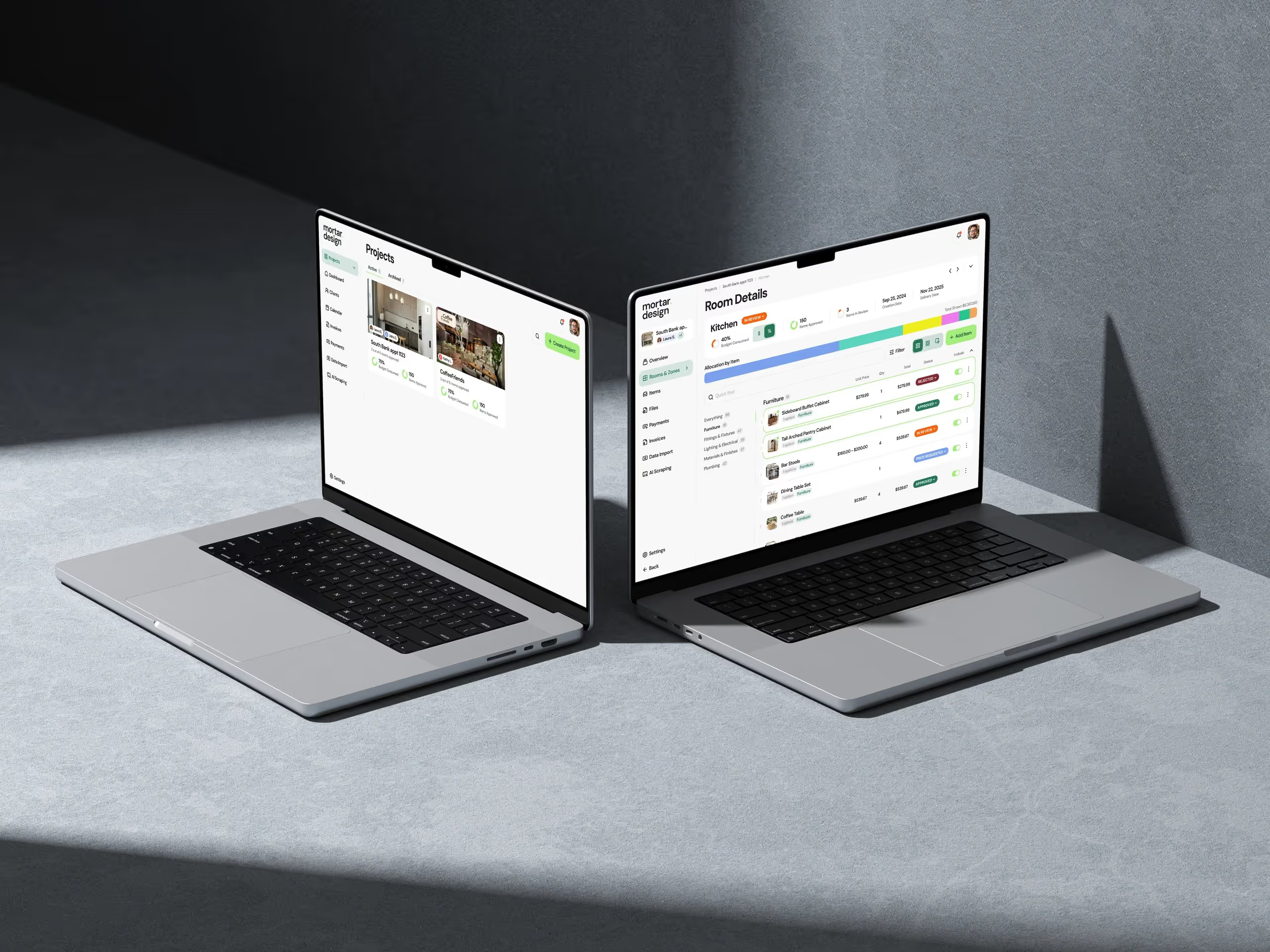
We just wrapped three AI-native builds — an HR matching platform, a real estate document processor, and an interior design visualization tool. The cost patterns were surprisingly consistent. Let me break down what you actually need to budget.
The Hidden Infrastructure Tax Nobody Talks About
Your first shock will be infrastructure. Traditional SaaS? Maybe $500/month to start. AI SaaS? Budget $2,500-$5,000/month from day one. We learned this the hard way with our HR matching platform. Started with a basic setup, thinking we'd scale gradually. Wrong. AI workloads are bursty — one user uploads 50 resumes, your system needs to process them now, not queue them for later.
Here's what caught us off guard: vector databases aren't optional anymore. Every AI product needs semantic search, and that means Pinecone, Weaviate, or Qdrant. Budget $500-$2,000/month depending on your document volume. Our real estate client processes 10,000 documents monthly — their Pinecone bill alone is $1,800.

"The infrastructure cost isn't just servers anymore. It's specialized databases, GPU time, model hosting, and redundancy for when OpenAI goes down. Because it will go down."
Model API Costs: The Variable That'll Make or Break You
Everyone talks about ChatGPT pricing. Nobody talks about production reality. Your users won't write neat little prompts. They'll upload 40-page contracts and expect instant analysis. They'll want their entire database re-indexed when you update your embeddings model. The costs add up fast.
From our recent builds, here's realistic API spend by user tier. Small team (under 50 users): $1,000-$3,000/month. Medium deployment (50-500 users): $5,000-$15,000/month. Enterprise scale (500+ users): $20,000+/month. These aren't worst-case scenarios — they're averages from actual deployed products.
The killer is context windows. GPT-4 Turbo with 128k context? Amazing for complex documents. Also $30 per million tokens. Process one mortgage application with full context, that's $0.50 in API costs alone. Do that for 1,000 applications daily, you're looking at $15,000/month just in OpenAI fees. Our real estate document processor hit this wall hard — we had to rebuild our chunking strategy to keep costs manageable.
Smart teams are getting creative. We now use a cascade approach: cheap models for initial classification, expensive models only for complex reasoning. Cut our API costs by 60% without users noticing. But implementing this added three weeks to development. Everything in AI is a trade-off between cost, quality, and development time.

Development Hours: Why AI Products Take 3x Longer Than You Think
Traditional SaaS development is predictable. Build features, test them, ship. AI development? It's experimental by nature. That HR matching algorithm we built? Version one had 50% accuracy. Version twelve finally hit 85%. Each iteration took a week of prompt engineering, testing, and refinement.
Here's what we've seen across projects. Basic AI features (document classification, simple Q&A): 200-400 development hours. Intermediate complexity (semantic search, workflow automation): 600-1,200 hours. Advanced systems (multi-agent reasoning, complex document understanding): 1,500-3,000 hours. And that's just for MVP. Production-ready? Double those numbers.
The time sink isn't coding — it's evaluation. How do you know if your AI is actually working? You need test sets, evaluation metrics, human review processes. Our interior design tool seemed perfect in testing. Then real users uploaded photos of empty rooms, and the AI started hallucinating furniture that wasn't there. Fixing edge cases like this consumed 40% of our total development time.
Talent costs more too. AI developers who actually ship products (not just prototype) command $200-$400/hour. Full-stack developers who understand prompt engineering, vector databases, and model deployment are rare. We've started training our existing team — cheaper long-term, but adds 2-3 months to project timelines.
The Ongoing Costs Everyone Forgets to Budget
Launching is just the beginning. AI products have ongoing costs traditional SaaS doesn't. Model retraining when performance degrades. Prompt optimization as models update. Infrastructure scaling that's far less predictable than traditional apps.
Real numbers from our deployed products: Monthly model maintenance: $5,000-$15,000 (depending on complexity). Prompt engineering updates: 20-40 hours/month. Infrastructure optimization: 10-20 hours/month. Data quality monitoring: $2,000-$5,000 in tools and time. These aren't optional — skip them and watch your AI degrade within months.
The worst surprise? Legal and compliance. AI products need different terms of service, privacy policies, and data handling procedures. Our HR platform required $25,000 in legal reviews because we're processing sensitive candidate data. Budget at least $10,000-$30,000 for legal, more if you're in regulated industries.
Then there's the human-in-the-loop cost. Every AI product needs human oversight. Our real estate tool processes contracts automatically but flags 15% for human review. That's two full-time contractors just for quality control. Budget for this from day one or face angry customers when your AI makes inevitable mistakes.
Strategic Decisions That Cut Costs Without Cutting Corners
After burning through budgets on early projects, we've learned what actually saves money. First, start with narrow use cases. Our interior design tool originally tried to do everything — room layouts, furniture selection, color schemes. We refocused on just furniture visualization and cut development time by 60%.

Second, build evaluation infrastructure first. Sounds backwards, but it saves months of guesswork. Spend two weeks building proper testing frameworks, save two months of "why isn't this working?" debugging. Our HR matching platform would've launched six months earlier if we'd done this from the start.
Third, plan for model diversity. Don't lock yourself into one provider. OpenAI is amazing but expensive. Claude is great for analysis but has tighter rate limits. Open source models are getting good enough for many tasks. Build abstraction layers early — switching providers should take hours, not weeks.
"The cheapest AI product is one that solves a real problem well. Everything else is just expensive experimentation."
Your 2026 AI Product Budget Template
Let's get specific. For a typical AI SaaS product launching in 2026, here's your realistic budget breakdown. Development phase (6-9 months): $150,000-$400,000 for the team, $30,000-$60,000 for infrastructure and APIs, $20,000-$40,000 for tools and services. Total pre-launch: $200,000-$500,000.

These numbers assume you're building something real — not a wrapper around ChatGPT. If you're doing simple prompt engineering, cut these by 70%. But if you're building specialized AI for niche industries (like we do at Dazlab.digital), these are your real costs.
The good news? AI products can charge premium prices. Our HR platform replaced a $50,000/year enterprise tool with something 10x better. Customers happily pay $5,000/month because the ROI is obvious. Price for value, not cost.
Making the Build vs. Buy vs. Partner Decision
After seeing these numbers, you're wondering if you should build at all. Fair question. Here's how we guide clients through this decision. Build internally if: you have AI expertise in-house, your use case is truly unique, or AI is your core differentiator. The control and customization are worth the cost.
Buy existing tools if: your needs are generic, you're time-constrained, or you're testing market demand. Plenty of good AI tools exist for common use cases. No shame in starting there.
Partner with specialists (like Dazlab.digital) if: you need custom AI for a specific niche, you want to move fast without hiring a full team, or you need expertise in both AI and your specific industry. We've built enough AI products to avoid the expensive mistakes.
Whatever you choose, start small. Every successful AI product we've built began as something much simpler. Our interior design tool started as a basic color palette generator. The HR platform began matching just skills, not culture fit. Build the simple thing first, validate it works, then expand.
The AI gold rush is real, but it's not cheap. Budget realistically, focus ruthlessly, and solve real problems. Do that, and the costs become investments. Try to build everything for everyone? That's how you burn through $500,000 with nothing to show for it.
Ready to build your AI-native product? We've done this enough times to know the pitfalls. Whether you need strategic guidance on your AI roadmap or a partner to build and launch your product, let's talk real numbers for your specific use case. The best time to plan your AI product budget is before you start burning through it.
Frequently Asked Questions
How much does it really cost to build an AI SaaS product?
Based on our recent builds at Dazlab.digital, expect $200,000-$500,000 for development (6-9 months) and $25,000-$95,000 monthly post-launch. This includes development team, infrastructure, API costs, and ongoing maintenance. Simple ChatGPT wrappers cost 70% less, but specialized AI for niche industries requires this full investment.
What are the biggest hidden costs in AI product development?
The three biggest surprises are infrastructure ($2,500-$5,000/month minimum vs $500 for traditional SaaS), vector databases ($500-$2,000/month), and human-in-the-loop quality control (2+ full-time contractors). Most teams also underbudget for legal compliance ($10,000-$30,000) and ongoing prompt optimization (20-40 hours monthly).
How do AI development timelines compare to traditional software?
AI products typically take 3x longer than traditional software. Basic AI features need 200-400 hours, intermediate complexity requires 600-1,200 hours, and advanced systems take 1,500-3,000 hours just for MVP. The extra time goes to experimentation, evaluation infrastructure, and edge case handling — our HR matching algorithm went through 12 iterations before reaching acceptable accuracy.
When should we build custom AI vs using existing tools?
Build custom if you have in-house AI expertise, truly unique use cases, or AI is your core differentiator. Buy existing tools for generic needs or when testing market demand. Partner with specialists like Dazlab.digital when you need custom AI for specific niches but want to move fast without building a full team.
What's the most effective way to reduce AI product costs?
Start with narrow use cases — our interior design tool cut development time by 60% by focusing on just furniture visualization instead of everything. Use cascade approaches (cheap models for classification, expensive only for complex tasks) to cut API costs by 60%. Build evaluation infrastructure first to avoid months of debugging. Most importantly, solve real problems well rather than building expensive experiments.
Related: step-by-step AI-native SaaS development process
Related: technical implementation of vector databases for SaaS
Related: defining your technical specifications checklist
Related Reading
Dazlab is a Product Studio_
Our products come first. Consulting comes second. Whichever path you take, you’ll see how a small team can deliver outsized results.