
After 25 years of building software and launching niche SaaS products, I've watched countless founders agonize over this fundamental question: should we build for everyone or master one market? The answer shapes everything — from your product roadmap to your pricing strategy to whether you'll still be in business five years from now.
This article is part of our complete guide to vertical SaaS.

Here's what most people get wrong: they think it's about market size. Build horizontal and you get the whole pie. Build vertical and you're stuck with a slice. But that's not how it works. I've seen vertical SaaS companies with 50 employees outperform horizontal platforms with 500. The difference isn't the size of the market — it's how well you serve it.
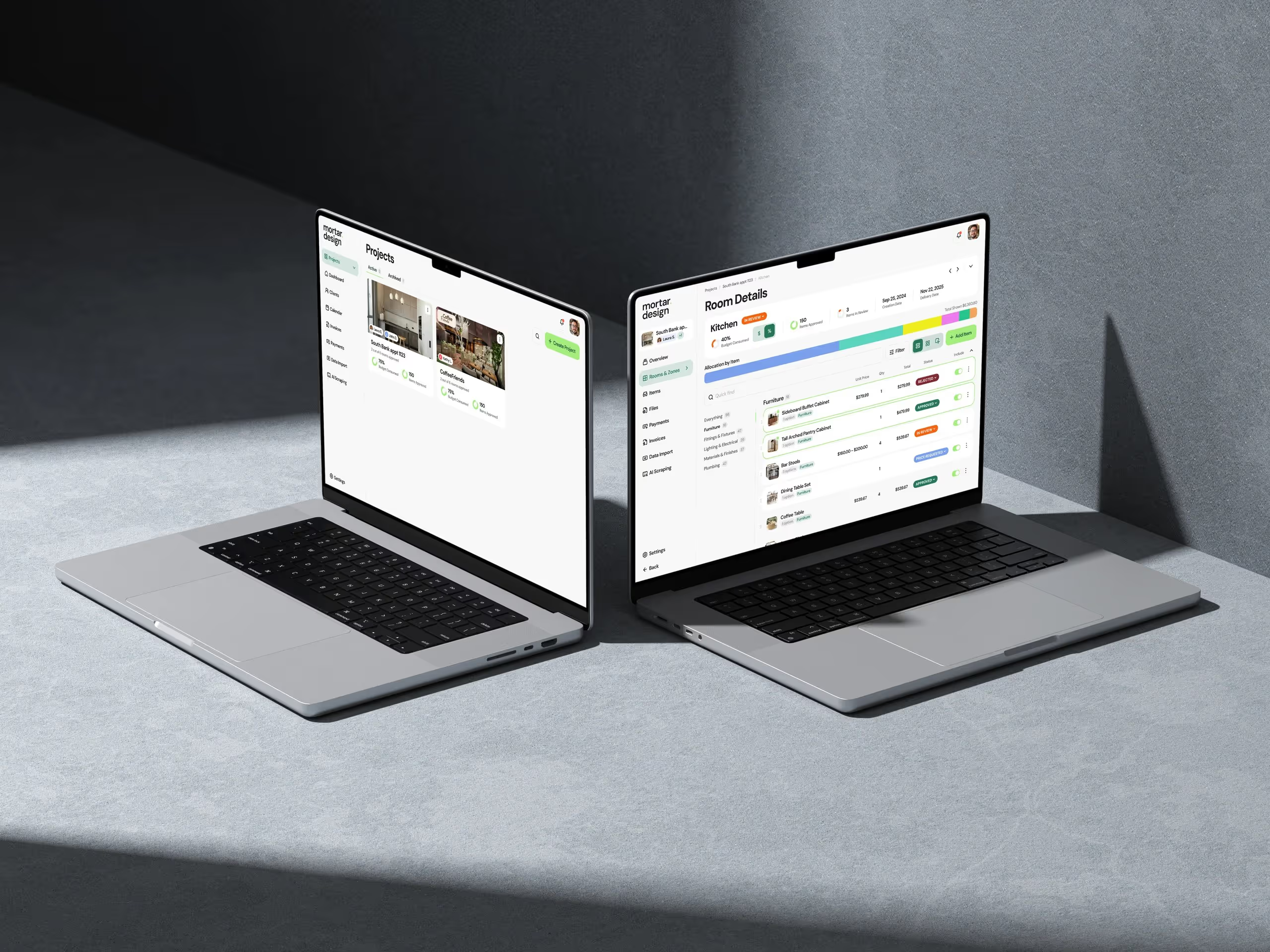
At Dazlab.digital, we've built products for both models. We've created specialized tools for interior designers that solve problems Asana never will. We've also built broader platforms that compete directly with horizontal giants. Each path has its own playbook, and mixing them up is where most founders fail.
The Real Difference Between Vertical and Horizontal SaaS
Let's cut through the textbook definitions. Horizontal SaaS solves a common problem across multiple industries. Think Slack for team communication, Stripe for payments, or HubSpot for marketing. These tools work whether you're running a law firm or a bakery because every business needs to communicate, process payments, and market their services.
Vertical SaaS flips the script. Instead of solving one problem for everyone, it solves every problem for one specific industry. When we built software for real estate associations, we didn't just handle their member management — we built in MLS integration, continuing education tracking, and compliance reporting. Features that would be useless to 99% of businesses but are mission-critical to that 1%.
The distinction goes deeper than features. It's about speaking the language. A horizontal CRM calls them "contacts." A vertical CRM for medical practices calls them "patients" and knows the difference between a referring physician and a primary care provider. These aren't just label changes — they represent fundamentally different data models, workflows, and business logic.

The Vertical SaaS Business Model: Deep Roots Win
The vertical SaaS business model is built on a simple premise: become indispensable to a specific industry. This isn't about building more features — it's about building the right features so well that switching to anything else would be professional malpractice.
Take our HR tech products. We don't compete with Workday on feature count. We win because we understand that small recruiting agencies don't need 47 different reports — they need three reports that actually match what their clients ask for. We know their candidates come from specific job boards, their contracts follow industry-standard terms, and their commission structures have quirks that generic payroll software treats as errors.
The economics of vertical SaaS are counterintuitive. You'd think a smaller market means smaller opportunity. But industry estimates suggest vertical SaaS companies often achieve 120-150% net revenue retention compared to 100-110% for horizontal players. Why? Because when you solve every problem for a specific industry, customers don't just renew — they expand. They add users, upgrade tiers, and buy every add-on because each one saves them real time on real problems.

Vertical SaaS also changes your go-to-market playbook entirely. Forget broad digital marketing campaigns. Success comes from showing up at industry conferences, speaking their language in trade publications, and building features based on regulatory changes they're worried about. When we launched a product for association management, our best marketing channel wasn't Google Ads — it was becoming friends with the consultants who help associations modernize their operations.
Why Horizontal SaaS Still Dominates Headlines
Open any tech publication and you'll see horizontal SaaS unicorns raising massive rounds. There's a reason for this bias: horizontal SaaS tells a better venture capital story. "We're building the next Salesforce" sounds more impressive than "We're digitizing dental practices in the Midwest." But impressive narratives don't always translate to sustainable businesses.
Horizontal SaaS has undeniable advantages. The total addressable market is massive — every business needs email, project management, and basic accounting. You can grow faster initially because you're not constrained by industry boundaries. Your marketing can cast a wider net, and you can pivot between customer segments without rebuilding your product.

But here's what the headlines miss: horizontal SaaS is a knife fight. You're competing with everyone, including companies with 100x your resources. Microsoft can decide tomorrow to add your core feature to Office. Google can launch a free version of your product. Even if you survive the giants, you're fighting 50 other startups who had the same "revolutionary" idea about reimagining project management.
The unit economics tell the real story. Horizontal SaaS companies typically spend 40-60% of revenue on sales and marketing because customer acquisition is so competitive. They face higher churn because switching costs are lower — moving from one generic tool to another is painful but possible. And customization requests come from every direction, pulling your product roadmap in 20 different ways.
The Hidden Costs of Each Model
Both models have costs that don't show up in your initial business plan. With vertical SaaS, you're betting your entire company on one industry. If that industry shrinks, changes regulations, or gets disrupted, you're vulnerable. We've seen this happen to companies that built exclusively for taxi companies or traditional retail.
The technical debt is also different. Vertical SaaS accumulates complexity from industry-specific requirements. That MLS integration for real estate software? It needs constant maintenance as standards change. Those compliance features for healthcare? They need updates every time regulations shift. You're not just maintaining software — you're maintaining deep industry expertise.
Horizontal SaaS faces its own hidden costs. The pressure to be everything to everyone leads to feature bloat. You start as a simple project management tool and end up with 200 features that 90% of users never touch. Performance suffers. Onboarding becomes a nightmare. And you still lose deals because you don't have that one specific feature some enterprise customer demands.
The talent requirements differ too. Vertical SaaS teams need industry insiders — people who've lived the problems you're solving. When we build for interior designers, we hire people who've actually run design projects, not just engineers who think they understand the space. Horizontal SaaS can hire generalists, but they need 10x more of them to cover all the use cases and edge scenarios.
Making the Choice: Questions That Actually Matter
Forget the generic framework slides. Here are the questions we ask clients at Dazlab.digital when helping them choose between vertical and horizontal SaaS:
Do you have unfair industry access? If you've spent 10 years in commercial real estate and know every major player, that's an asset you can't replicate in horizontal SaaS. Your industry connections, domain expertise, and reputation are moats that matter more than technical features.
What problem makes you angry? The best SaaS products come from founders who are personally frustrated by the status quo. If you're angry that every dentist still uses paper forms, build vertical. If you're angry that all project management tools suck regardless of industry, build horizontal. Anger sustains you through the hard years better than market analysis.
How patient is your capital? Vertical SaaS often takes longer to hit venture-scale metrics. You might need three years to saturate your initial market before expanding to adjacent verticals. Horizontal SaaS can show faster initial traction but faces a longer, more expensive path to profitability. Match your model to your runway.
Can you stomach saying no? Vertical SaaS means saying no to 99% of potential customers because they're not in your industry. That discipline is harder than it sounds when a big check is on the table. Horizontal SaaS means saying no to feature requests that would perfect your product for specific industries. Both require discipline, just different kinds.
The Hybrid Path: When Breaking the Rules Works
The binary choice between vertical and horizontal is sometimes false. We've seen successful companies start vertical and expand horizontally — or vice versa. But timing and execution matter more than strategy here.
Toast started as restaurant-specific POS software. Pure vertical play. But restaurants taught them about the broader hospitality industry, and their payments infrastructure could extend beyond food service. They stayed vertical enough to maintain their advantage while expanding horizontally into adjacent markets. The key? They didn't try to become Square overnight. They moved deliberately into markets where their restaurant expertise provided unique insights.
The opposite path is harder but possible. Some horizontal tools find a vertical where they have unexpected product-market fit and double down. But this usually requires admitting that your horizontal dreams were wrong — a psychological barrier many founders can't cross.
At Dazlab.digital, we've helped companies navigate both transitions. The successful ones share a pattern: they expand from a position of strength, not desperation. They've dominated their initial market (whether vertical or horizontal) before moving. And they treat expansion as a new product launch, not a marketing campaign.
The choice between vertical and horizontal SaaS isn't about the size of your ambition — it's about the depth of your understanding. Master one before you chase many.
Your Model Shapes Everything Else
Here's what most founders realize too late: choosing between vertical and horizontal SaaS isn't just a product decision. It cascades through every aspect of your business.
Pricing changes completely. Vertical SaaS can charge more because you're replacing multiple tools and manual processes. We've seen specialized software for law firms charge 10x what generic alternatives cost — and deliver 20x the value. Horizontal SaaS faces constant price pressure from free alternatives and venture-funded competitors willing to burn cash for market share.
Your team composition shifts. Vertical SaaS companies often look weird to traditional software investors — half the team might come from the industry you serve. Your head of product might be a former hospital administrator. Your sales team might be mostly former insurance brokers. This industry DNA is a feature, not a bug.
Even your company culture diverges. Vertical SaaS teams develop deep empathy for their specific users. They attend industry conferences not to sell but to learn. They read trade publications and understand regulatory changes. Horizontal SaaS teams optimize for scalability and abstractions — valuable skills, but different ones.
The path forward depends on honest self-assessment. Are you a master of one or a jack of all trades? Do you want to go deep or go wide? There's no wrong answer, but there are wrong reasons. Don't choose horizontal because it sounds more impressive. Don't choose vertical because it seems easier. Choose the model that aligns with your strengths, your market insights, and your definition of success.

Ready to build your next SaaS product but unsure which model fits your vision? Let's talk. We've been down both paths and can help you choose the one that matches your strengths and market opportunity.
Frequently Asked Questions
What's the main difference between vertical and horizontal SaaS?
Horizontal SaaS solves one common problem across multiple industries (like Slack for communication), while vertical SaaS solves multiple problems for one specific industry (like specialized software for dental practices). The key distinction is depth versus breadth — vertical goes deep into industry-specific needs while horizontal stays broad to serve everyone.
Which SaaS model is more profitable?
Vertical SaaS often achieves higher net revenue retention (120-150% vs 100-110% for horizontal) because customers expand usage over time and have higher switching costs. However, horizontal SaaS can reach larger markets faster. Profitability depends more on execution than model choice, though vertical SaaS typically has lower customer acquisition costs.
Can a SaaS company switch from horizontal to vertical (or vice versa)?
Yes, but it requires careful execution. Companies like Toast started vertical (restaurants) and expanded to adjacent markets. The key is expanding from a position of strength after dominating your initial market, not pivoting out of desperation. Treat expansion as launching a new product, not just a marketing campaign.
What type of team do I need for vertical vs horizontal SaaS?
Vertical SaaS teams need industry insiders who understand the specific market's problems, regulations, and workflows. Your head of product might come from the industry you serve. Horizontal SaaS teams can hire generalists but need more of them to cover diverse use cases and require strong abstraction and scalability skills.
How do I choose between building vertical or horizontal SaaS?
Consider four key factors: Do you have unfair access or expertise in a specific industry? What problem makes you personally angry enough to solve? How patient is your funding for growth? Can you maintain discipline to say no to opportunities outside your focus? Choose based on your strengths and market insights, not what sounds impressive.
Related Reading


Dazlab is a Product Studio_
Our products come first. Consulting comes second. Whichever path you take, you’ll see how a small team can deliver outsized results.