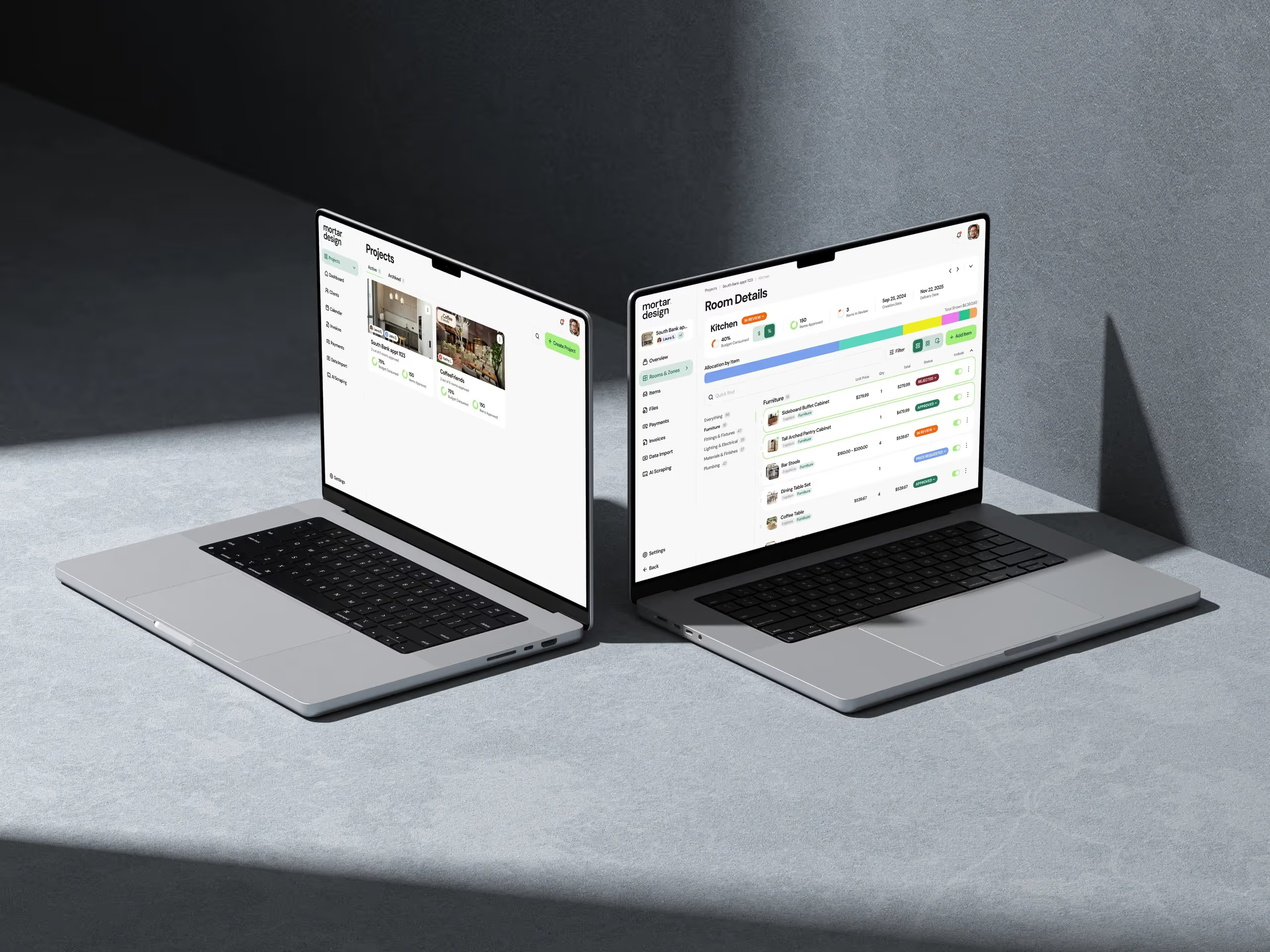

When we launched our first vertical SaaS product for interior designers, I made every pricing mistake in the book. We started at $99/month because that's what "everyone" charges for SaaS. Six months later, we had 12 customers and were bleeding cash. The problem wasn't the product — it was that we'd applied horizontal SaaS pricing logic to a vertical market.
This article is part of our complete guide to vertical SaaS.

Here's the thing about niche SaaS pricing models: you can't play the volume game. When your total addressable market is 50,000 businesses instead of 5 million, every pricing decision carries exponential weight. After building and pricing multiple vertical SaaS products at Dazlab.digital, I've learned that the conventional SaaS playbook goes out the window when you're serving specific industries.
The Fundamental Reality of Vertical SaaS Economics
Let me paint you a picture. There are roughly 100,000 interior design firms in the US. Maybe 20% are large enough to need dedicated software. That's 20,000 potential customers — total. Compare that to a horizontal project management tool that can target literally any business with more than five employees. The math is brutal.
This constraint shapes everything about vertical SaaS pricing. You need higher average contract values (ACVs) because you'll never hit the customer counts that horizontal players achieve. But here's the counterintuitive part: niche markets often support premium pricing better than broad markets. Why? Because you're solving expensive, specific problems that generic tools can't touch.
When we built project management software specifically for interior designers, we discovered they were already cobbling together three or four different tools — Asana for tasks, Dropbox for files, QuickBooks for invoicing, plus endless spreadsheets. The total cost? Often $300-500 per month in various subscriptions, not counting the hours lost to manual data entry and coordination. Suddenly, charging $299/month for an all-in-one solution designed specifically for their workflow wasn't expensive — it was a bargain.
Value-Based Pricing in Niche Markets
The biggest mistake I see in vertical SaaS pricing is copying horizontal SaaS tiers. You know the pattern: Starter at $29, Professional at $99, Enterprise at $299. This model assumes you need low entry points to capture volume. But in niche markets, low prices often signal low value.

The key is understanding what specific value you're creating. For recruiting firms, we calculated that our AI-powered candidate matching saved each recruiter about 10 hours per week. At their billing rates, that's $4,000-6,000 in recoverable time monthly. Against that math, $149 per seat is noise. Price based on value created, not on competitor benchmarks from different markets.
In vertical markets, your pricing model is your positioning. Low prices don't attract more customers — they attract the wrong customers.
Packaging Strategies That Actually Work
Forget the standard three-tier pricing every SaaS pricing guide recommends. In vertical markets, I've found two models consistently outperform everything else: the all-inclusive platform and the modular add-on approach.
The all-inclusive platform works when your customers' needs are relatively uniform. Our interior design software includes project management, client portals, invoicing, and vendor coordination in one package. No tiers, no feature gates. Everyone gets everything for one price. This simplicity resonates in industries where buyers aren't software-savvy and just want their problems solved.

The modular approach works better in more diverse verticals. For a real estate association management platform we built, base functionality costs $X per month, with specific modules (event management, member directories, certification tracking) as add-ons. This lets smaller associations start affordably while larger ones can build comprehensive solutions. The key is making the base product genuinely useful on its own, not crippled to force upgrades.
What doesn't work? Feature-based tiers that make no sense to industry users. I've watched competitors gate basic functionality like "unlimited projects" in project management software. Interior designers don't think in "projects per month" — they think in active clients and total revenue managed. Align your packaging with how your market actually operates.
Implementation vs. Subscription Revenue Models
Here's something the typical SaaS playbook won't tell you: in many vertical markets, implementation fees are your friend. We fought this for years, thinking everything should be pure subscription. Big mistake.

When selling to interior design firms, we discovered that charging $2,000-5,000 for implementation and training accomplished three things. First, it qualified serious buyers — nobody drops $5K unless they're committed to making the software work. Second, it funded the high-touch onboarding these markets require. Third, it improved retention dramatically because customers had skin in the game.
The trick is positioning implementation fees as investment in success, not a penalty for choosing your product. We frame it as "Success Package" or "White Glove Onboarding" and include specific deliverables: data migration, workflow customization, team training, and 90-day success reviews. For a design firm doing $2M in annual revenue, spending $5K to properly implement software that will manage every client project is a no-brainer.
Industry estimates suggest that proper onboarding can improve first-year retention by 20-30% in vertical SaaS markets. Our experience backs this up — customers who go through paid implementation renew at nearly 95% rates versus 70% for self-service signups.
Geographic and Segment-Based Pricing
One advantage of serving specific verticals is that you understand the economic realities of different segments within that market. A design firm in Manhattan operates on different economics than one in Memphis. Yet most vertical SaaS products price uniformly across geographies.
We've experimented with geographic pricing through indirect methods. Instead of listing different prices (which feels unfair), we've created different product packages that naturally align with market segments. Our "Studio" package for interior designers includes features that matter more to urban firms — sophisticated client presentation tools, complex project hierarchies, multi-location inventory tracking. Our "Boutique" package focuses on solo designers and small partnerships with streamlined workflows.
The result? Urban firms gravitate toward the higher-priced Studio package ($399/month) while smaller regional firms choose Boutique ($199/month). Same core product, different feature sets that match market realities. No awkward conversations about why someone pays more for the same thing.
For B2B verticals with clear size segments, we've had success with transparent tier pricing based on objective metrics. Our association management software prices on member count — under 500 members, 500-2000, and 2000+. This feels fair because larger associations genuinely create more load on the system and typically have bigger budgets.
The Psychology of Pricing Niche Software
After years of testing different pricing strategies across multiple vertical SaaS products at Dazlab.digital, I've noticed patterns in how niche markets respond to pricing that contradict conventional wisdom.

Second, price anchoring works differently in vertical markets. In horizontal SaaS, you anchor against competitors. In vertical markets, anchor against the problem cost. When we pitch our recruiting software, we don't talk about competitor pricing — we calculate how much bad hires cost (typically $15,000-50,000 each) and how much time recruiters waste on manual screening (10-15 hours weekly). Against those numbers, our pricing feels trivial.
Third, social proof within the vertical matters more than raw customer counts. Saying "trusted by 10,000 companies" means nothing if those companies aren't in your prospect's industry. But "used by 8 of the top 20 interior design firms in New York" carries massive weight. We've learned to optimize our pricing pages for vertical-specific social proof rather than generic testimonials.
Practical Pricing Tactics from the Trenches
Let me share some specific tactics that have worked across multiple Dazlab.digital products. These aren't theoretical — they're based on real pricing decisions we've made and measured.
The "Industry Standard" Premium: In mature verticals, there's often established software charging outdated prices. We've successfully priced 20-30% above these incumbents by positioning ourselves as "modern" or "next-generation." Old software charging $199/month? We come in at $259 with better UX and modern features. Buyers expect to pay more for better.
The "Pilot Program" Close: For new verticals where pricing is uncertain, we offer 3-month pilot programs at 50% off with the explicit agreement that we'll work together to find the right long-term price. This gets customers in the door while giving us pricing discovery. About 80% convert to full price after seeing value.
The "Success Metric" Guarantee: Instead of free trials (which have terrible conversion in vertical markets), we offer success guarantees tied to specific metrics. For our interior design software: "Reduce project management time by 30% in 90 days or get 6 months free." This forces the value conversation and attracts serious buyers.
Bundle Everything Possible: Vertical buyers hate managing multiple vendors. We've increased ACVs by 40-60% by bundling adjacent services — hosting, backups, training, support, even industry-specific integrations — into single SKUs. A design firm would rather pay you $500/month for everything than manage five $100/month subscriptions.
Making the Jump: When to Raise Prices
The hardest part of vertical SaaS pricing isn't setting initial prices — it's raising them as you add value. We've learned to view price increases as a natural part of product evolution, not a betrayal of early customers.
Our rule of thumb: when you've added enough value to justify a 50% price increase, it's time to move. For existing customers, we grandfather them for 12 months, then offer a 25% "loyalty discount" off new pricing. This rewards early adopters while moving toward sustainable unit economics.
The key is constant communication about value being added. Every product update email reinforces the ROI story. By the time we announce a price increase, customers are thinking "finally — this was underpriced." We've done this successfully three times with our interior design software, moving from $99 to $149 to $199 to $299/month over four years.
Remember: in vertical SaaS, you're not optimizing for maximum customer count. You're optimizing for sustainable growth within a finite market. That means pricing for value, not volume, and having the confidence to charge what your solution is actually worth. The alternative — trying to make venture-scale returns on horizontal SaaS pricing in a vertical market — is a recipe for failure. Trust me, I've been there.
Building vertical SaaS products at Dazlab.digital has taught me that SaaS pricing strategy in niche markets requires throwing out most conventional wisdom. Price for value, not volume. Package for simplicity, not options. And always remember: in a market of 20,000 potential customers, every pricing decision is make-or-break. Get it right, and you've built a sustainable business. Get it wrong, and no amount of product excellence will save you.
Frequently Asked Questions
Q: How do you determine the right price point for a vertical SaaS product when there are few competitors?
Focus on the value you're creating rather than competitor benchmarks. Calculate the cost of the problem you're solving — whether that's hours saved, revenue increased, or risks mitigated. For example, if your software saves 10 hours per week for someone billing $400/hour, you're creating $4,000 in monthly value. Price as a fraction of that value, not based on what horizontal SaaS products charge.
Q: Should vertical SaaS companies offer free trials or freemium tiers?
Generally no. Free trials have poor conversion rates in vertical markets because the value requires proper implementation and training. Instead, consider paid pilots, success guarantees, or comprehensive demos. Freemium rarely works because vertical markets are too small to support the conversion ratios that freemium requires.
Q: How do you handle price increases for existing customers in niche markets?
Grandfather existing customers for 12 months to show loyalty, then offer a discount off new pricing (typically 25% works well). The key is constant communication about value being added before the increase. Make sure customers feel the product is already underpriced by the time you announce the change.
Q: What's the biggest mistake in vertical SaaS pricing?
Copying horizontal SaaS pricing tiers (Starter/Pro/Enterprise at $29/$99/$299). This model assumes you need low entry points for volume, but vertical markets respond better to premium pricing that signals value. Low prices often indicate low sophistication to industry buyers.
Q: How important are implementation fees in vertical SaaS?
Critical. Implementation fees of $2,000-5,000 accomplish three things: qualify serious buyers, fund necessary high-touch onboarding, and improve retention by creating customer investment. Companies that go through paid implementation renew at ~95% rates versus 70% for self-service signups.
Related Reading


Dazlab is a Product Studio_
Our products come first. Consulting comes second. Whichever path you take, you’ll see how a small team can deliver outsized results.