After building software for 25 years, I've seen plenty of technology waves. But AI-native products are fundamentally different. These aren't existing tools with AI features bolted on — they're products that literally couldn't exist without AI at their core.
This article is part of our complete guide to AI-native software development.

We've been exploring this space deeply at Dazlab.digital, especially through our work on products like Handl. The distinction matters because AI-native products solve problems in ways that were impossible just two years ago. They're not competing on features; they're creating entirely new categories.
Let me walk you through 15 real examples of AI-native products, starting with some you might not know but should, and explain what makes each one fundamentally different from traditional software.
The New Wave: Vertical AI-Native Products
1. Handl - AI-Native Design Project Management
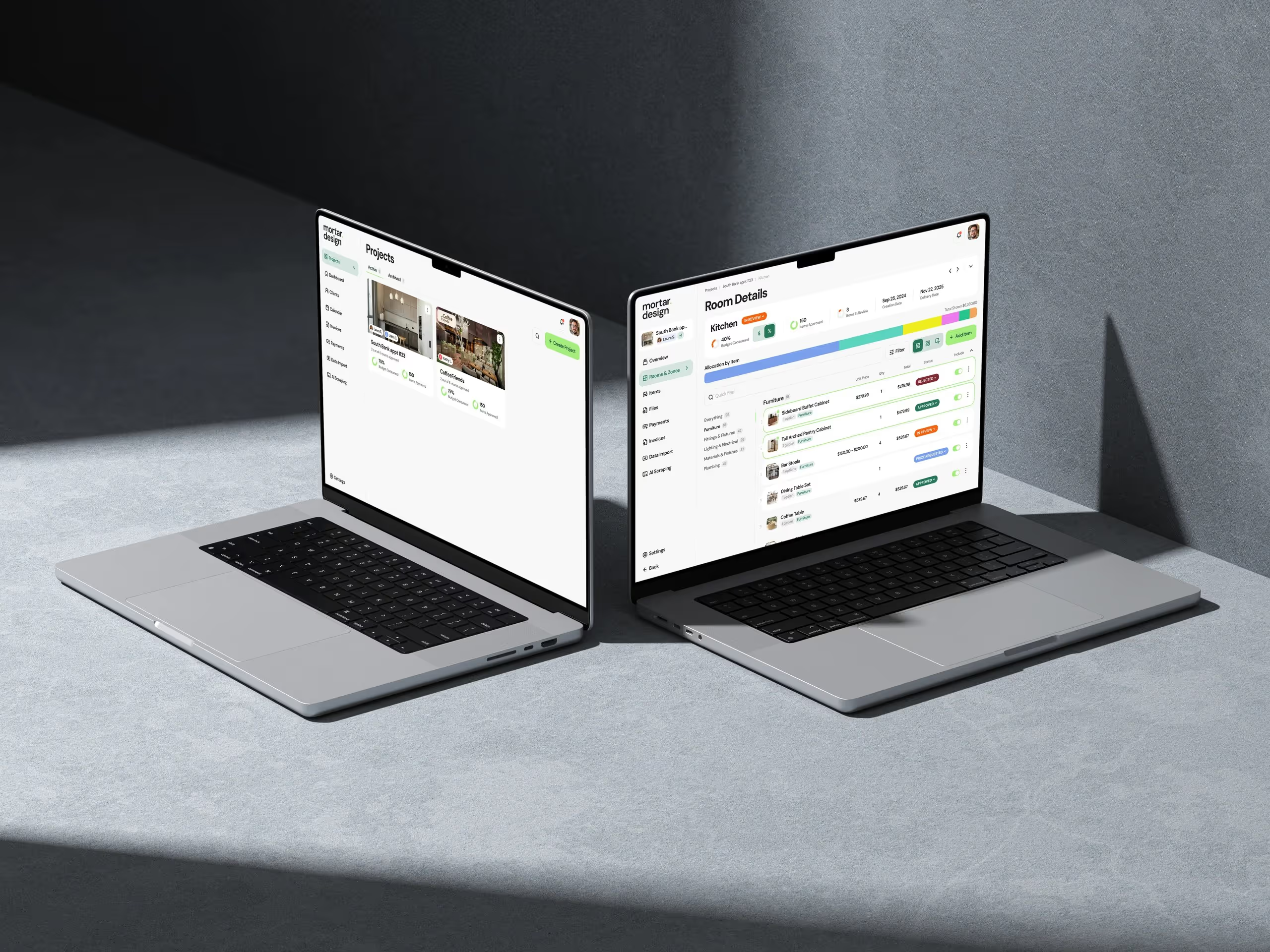
Handl represents what I think is the future of vertical SaaS: AI-native solutions for specific industries. Built specifically for interior designers, Handl uses AI to automatically extract product details from photos, generate shopping lists, and manage client approvals — tasks that would be impossible without computer vision and natural language processing.
What makes it AI-native? The core value proposition depends entirely on AI's ability to understand visual content and context. You literally couldn't build Handl's main features without AI. It's not a project management tool with AI added; it's an AI system wrapped in a project management interface.
Interior designers using Handl report saving 10+ hours per week on administrative tasks. That's not because it has better features than traditional PM tools — it's because AI enables an entirely different workflow.
2. mber - AI-First Property Intelligence

The AI-native difference shows in how mber processes information. Upload a video walkthrough of a property, and within minutes you have detailed condition reports, renovation estimates broken down by room, and comparative market analysis. This isn't automation of existing processes — it's a completely new approach enabled by AI's ability to "see" and understand physical spaces.
Real estate professionals we've spoken with describe mber as transformative because it changes when and how property analysis happens. Instead of scheduling inspections and waiting days for reports, initial assessments happen instantly, changing deal dynamics entirely.
3. Arbeo - Conversational HR Intelligence
Arbeo exemplifies AI-native thinking in HR tech. Rather than building another applicant tracking system with AI features, Arbeo lets HR teams have natural conversations with their data. Ask "Who are our top performers who might be flight risks?" and get nuanced answers that consider performance data, engagement surveys, and communication patterns.
Traditional HR analytics tools require predefined queries and reports. Arbeo's AI-native approach means every question can be answered without building new reports or dashboards. The product literally couldn't exist without large language models that understand context and can reason about complex organizational dynamics.
HR managers tell us Arbeo feels less like using software and more like having a knowledgeable colleague who has perfect recall of every employee interaction, review, and data point. That's the hallmark of AI-native design — the technology disappears into the experience.
The Pioneers: Consumer AI-Native Products
4. ChatGPT - The Conversational Intelligence Platform
ChatGPT might seem obvious, but it's worth examining why it's truly AI-native. Unlike traditional chatbots that follow decision trees, ChatGPT generates entirely new responses based on context and training. You couldn't build ChatGPT's core functionality with traditional programming — it requires neural networks trained on vast amounts of text.

What's interesting from a product perspective is how ChatGPT has evolved. OpenAI didn't just build a better chatbot; they created a new interface paradigm for interacting with information and completing tasks. The product's value is inseparable from its AI capabilities.
We've integrated similar conversational AI into several client projects, and the pattern is consistent: users interact with these systems in ways they'd never interact with traditional software. They explore, experiment, and discover capabilities through conversation rather than learning features.
5. Midjourney - AI-Native Creative Tool
Midjourney represents pure AI-native design in creative tools. You literally cannot create images from text descriptions without AI. It's not Photoshop with AI features — it's an entirely new creative paradigm where the AI is the creative engine and humans provide direction.
The Discord-based interface might seem quirky, but it reflects AI-native thinking. The product is about creative collaboration with AI, not traditional tool mastery. Users don't learn techniques; they learn how to communicate creative intent to an AI system.
From a product design perspective, Midjourney teaches us that AI-native products often require entirely new interaction patterns. The prompt-based interface that seemed alien two years ago now feels natural to millions of users.
6. GitHub Copilot - AI-Native Development Assistant
Copilot shows how AI-native products transform professional workflows. It's not an autocomplete feature — it's an AI system that understands code context, programming patterns, and developer intent. The product generates entire functions, suggests architectural patterns, and even writes documentation.
What makes Copilot AI-native is that its core value — understanding programming intent and generating contextually appropriate code — is impossible without large language models trained on millions of repositories. Traditional IDEs could offer snippets and templates; only AI can offer contextual code generation.
In our development work at Dazlab.digital, Copilot has fundamentally changed how we approach certain tasks. It's not about writing less code; it's about focusing on architecture and logic while AI handles implementation details.
The Specialists: Domain-Specific AI-Native Products
7. Perplexity - AI-Native Search
Perplexity reimagines search as a conversational, source-cited experience. Unlike traditional search engines that return links, Perplexity synthesizes information from multiple sources into coherent answers. This isn't possible without AI's ability to understand, summarize, and cite sources.

The AI-native aspect shows in how Perplexity handles follow-up questions. Each query builds on previous context, creating research sessions rather than isolated searches. Traditional search engines treat each query independently; Perplexity maintains conversational context throughout.
For knowledge workers, Perplexity represents a fundamental shift in how research happens. Instead of opening dozens of tabs and manually synthesizing information, the AI does the synthesis while maintaining source attribution.
8. Tome - AI-Native Presentation Creation
Tome approaches presentations from an AI-native perspective. Instead of providing templates and design tools, Tome generates entire presentations from prompts, automatically creating layouts, finding relevant images, and writing copy. The AI doesn't assist with presentation creation — it is the creation engine.
Traditional presentation tools like PowerPoint assume users know what they want to create. Tome assumes users know their goal but want AI to handle execution. This inversion is characteristic of AI-native products: they shift the user's role from creator to director.
We've used Tome for client presentations and found it changes the creative process. Instead of spending hours on slide design, we iterate on narrative and messaging while AI handles visual execution.
9. Descript - AI-Native Media Editing
Descript revolutionizes video editing by treating video as text. Its AI transcribes video, then lets you edit video by editing the transcript. Delete a word from the transcript, and that moment disappears from the video. This approach is impossible without AI speech recognition and synthesis.
The AI-native design extends to features like overdub, where AI clones your voice to fix mistakes without re-recording. Traditional video editors work with timelines and clips; Descript works with words and meanings.
For content creators, Descript represents a paradigm shift. Video editing becomes as simple as document editing, democratizing a previously technical skill. That's the power of AI-native design — it doesn't just improve existing workflows; it creates entirely new ones.
The Innovators: AI-Native Business Tools
10. Jasper - AI-Native Content Creation
Jasper pioneered AI-native content creation for business. Unlike traditional content tools that help with formatting and publishing, Jasper generates content from briefs. The entire product exists because AI can understand context and generate human-like text at scale.
What's interesting about Jasper is how it's evolved from simple generation to complex workflows. The product now includes brand voice training, campaign management, and performance optimization — all built on the foundation of AI content generation.
Marketing teams using Jasper report not just efficiency gains but fundamental changes in how they work. Instead of writer's block, they face choice paralysis from too many good options. That's a uniquely AI-native problem.
11. Synthesia - AI-Native Video Production
Synthesia creates professional videos using AI avatars and voices, eliminating the need for cameras, actors, or studios. This isn't video editing software with AI features — it's an entirely new approach to video creation enabled by AI's ability to generate realistic human avatars and speech.
The AI-native approach shows in the production workflow. Traditional video production involves pre-production, shooting, and post-production. Synthesia collapses this into a single step: write a script, choose an avatar, and generate. The time from idea to finished video drops from weeks to minutes.
Corporate training teams we've worked with describe Synthesia as transformative because it changes the economics of video production. When creating a training video takes minutes instead of weeks, video becomes viable for many more use cases.
12. Copy.ai - AI-Native Marketing Automation
Copy.ai extends beyond content generation to complete marketing workflow automation. The platform uses AI to research topics, generate content ideas, write copy, and even suggest distribution strategies. It's not a writing tool with AI; it's an AI system designed for marketing workflows.
The AI-native design means Copy.ai can maintain context across entire campaigns. Generate a blog post, and it can automatically create social media posts, email sequences, and ad copy that maintain consistent messaging. Traditional marketing tools require manual coordination; Copy.ai's AI maintains coherence automatically.
Small marketing teams report that Copy.ai doesn't just save time — it enables them to execute strategies that would be impossible with their resources. That's the multiplier effect of AI-native products.
The Deep Tech: Infrastructure AI-Native Products
13. RunwayML - AI-Native Creative Suite
RunwayML provides AI-powered creative tools that would be impossible without machine learning. Features like background removal, style transfer, and motion tracking all depend on trained neural networks. But what makes it truly AI-native is how these tools work together in creative workflows.
Unlike traditional creative suites where each tool is separate, RunwayML's tools share AI understanding. The AI that removes backgrounds understands the same visual concepts as the AI that generates images, enabling seamless creative workflows.
Professional creators describe RunwayML as enabling entirely new creative possibilities. It's not about doing the same work faster — it's about creating things that weren't previously possible.
14. Replit - AI-Native Development Environment
Replit integrates AI throughout the development experience. Beyond code completion, it uses AI for debugging, deployment optimization, and even architectural suggestions. The AI isn't an add-on feature — it's woven into every aspect of the development process.
What makes Replit AI-native is how AI changes the development paradigm. Beginners can build complex applications by describing what they want. Experienced developers can focus on high-level design while AI handles implementation details.
We've seen non-technical founders use Replit to build functional prototypes in hours. That democratization of development is only possible with AI-native design.
15. Glean - AI-Native Enterprise Search
Glean reimagines enterprise search using AI to understand context across all company data. Unlike traditional search that matches keywords, Glean understands relationships between documents, people, and concepts. It answers questions rather than returning documents.
The AI-native approach means Glean improves automatically as it learns company-specific context. It understands that "Q4 planning doc" means different things in different departments and returns contextually appropriate results.
Enterprise teams report that Glean doesn't just find information faster — it surfaces insights that would remain hidden in traditional search. That's the power of AI-native design in enterprise software.
What Makes a Product Truly AI-Native?
After working with these products and building our own, I've identified key characteristics that separate AI-native from AI-enabled products:
Core Value Depends on AI: You literally couldn't deliver the product's main value without AI. Remove the AI from Handl, and you don't have a worse product — you have no product.
AI-native products solve problems that were unsolvable before. They don't compete on features with traditional software because they're playing an entirely different game. When we built Handl, we weren't trying to build a better project management tool — we were eliminating work that shouldn't exist.
New Interaction Paradigms: AI-native products often require users to interact in completely new ways. Prompt engineering, conversational interfaces, and creative collaboration with AI all represent new interaction paradigms that didn't exist in traditional software.
These new paradigms can feel foreign initially but quickly become natural. Two years ago, writing prompts for image generation seemed bizarre. Now millions do it daily. AI-native products teach users new ways of thinking about problems.
Continuous Learning and Adaptation: Unlike traditional software with fixed functionality, AI-native products improve through use. They learn from user interactions, adapt to specific contexts, and deliver increasingly personalized experiences.
This creates compound value over time. The longer you use an AI-native product, the more valuable it becomes. Traditional software delivers the same value on day 1000 as day 1; AI-native products deliver exponentially more value over time.
Building AI-Native Products: Lessons from the Trenches
Through our work at Dazlab.digital building products like Handl and consulting with companies creating AI-native solutions, we've learned several critical lessons:
First, start with problems that only AI can solve. Don't take an existing product and add AI features. Instead, identify problems that are impossible to solve without AI, then build the minimal product around that core capability.
Second, embrace new interaction paradigms. Users are more adaptable than we think. If the value is clear, they'll learn new ways of interacting with software. Don't constrain AI-native products with traditional UI patterns.
Third, plan for continuous iteration. AI-native products evolve rapidly as the underlying models improve. Build architectures that can adapt to new capabilities without major rewrites.
Finally, measure different metrics. Traditional SaaS metrics like feature adoption don't capture AI-native value. Instead, measure outcome improvements, time saved, and previously impossible tasks completed.
The shift to AI-native products represents the biggest change in software since the internet. We're not just building better tools — we're enabling entirely new ways of working. The examples above show what's possible today, but we're just scratching the surface.

Frequently Asked Questions
What's the difference between AI-native and AI-enabled products?
AI-native products fundamentally couldn't exist without AI at their core - their main value proposition depends entirely on AI capabilities. Products like Handl use AI to extract design details from photos, which would be impossible without computer vision. AI-enabled products, on the other hand, are traditional software with AI features added on top. The key test: if you removed the AI from an AI-native product, you'd have no product left, not just a less capable one.
How can I identify if a product is truly AI-native?
Look for three key characteristics: First, the core value must depend on AI - the product literally couldn't deliver its main benefit without AI technology. Second, it often introduces new interaction paradigms like prompt engineering or conversational interfaces. Third, the product improves through use, learning from interactions and delivering increasingly personalized experiences over time.
What makes vertical AI-native products like Handl different from general AI tools?
Vertical AI-native products combine AI capabilities with deep domain expertise to solve industry-specific problems. Handl, for example, understands interior design workflows and automatically extracts product details relevant to designers. This specialized focus enables them to deliver more value than general-purpose AI tools because they're built around specific industry workflows and pain points.
Why do AI-native products often require new ways of interacting with software?
AI-native products solve problems differently than traditional software, which requires different interaction patterns. Instead of clicking through menus and features, users might write prompts, have conversations, or direct AI through examples. These new paradigms match how AI systems process information - through natural language and pattern recognition rather than rigid commands.
How are companies using AI-native products to transform their workflows?
Companies report fundamental workflow changes, not just efficiency gains. Interior designers using Handl save 10+ hours weekly by eliminating manual product cataloging. HR teams using Arbeo get instant insights from conversational queries instead of building reports. Marketing teams using Jasper shift from writing content to directing AI and choosing from multiple options. The transformation isn't about doing the same work faster - it's about working in entirely new ways.
Related: the four primary types of AI software
Related Reading
Dazlab is a Product Studio_
Our products come first. Consulting comes second. Whichever path you take, you’ll see how a small team can deliver outsized results.