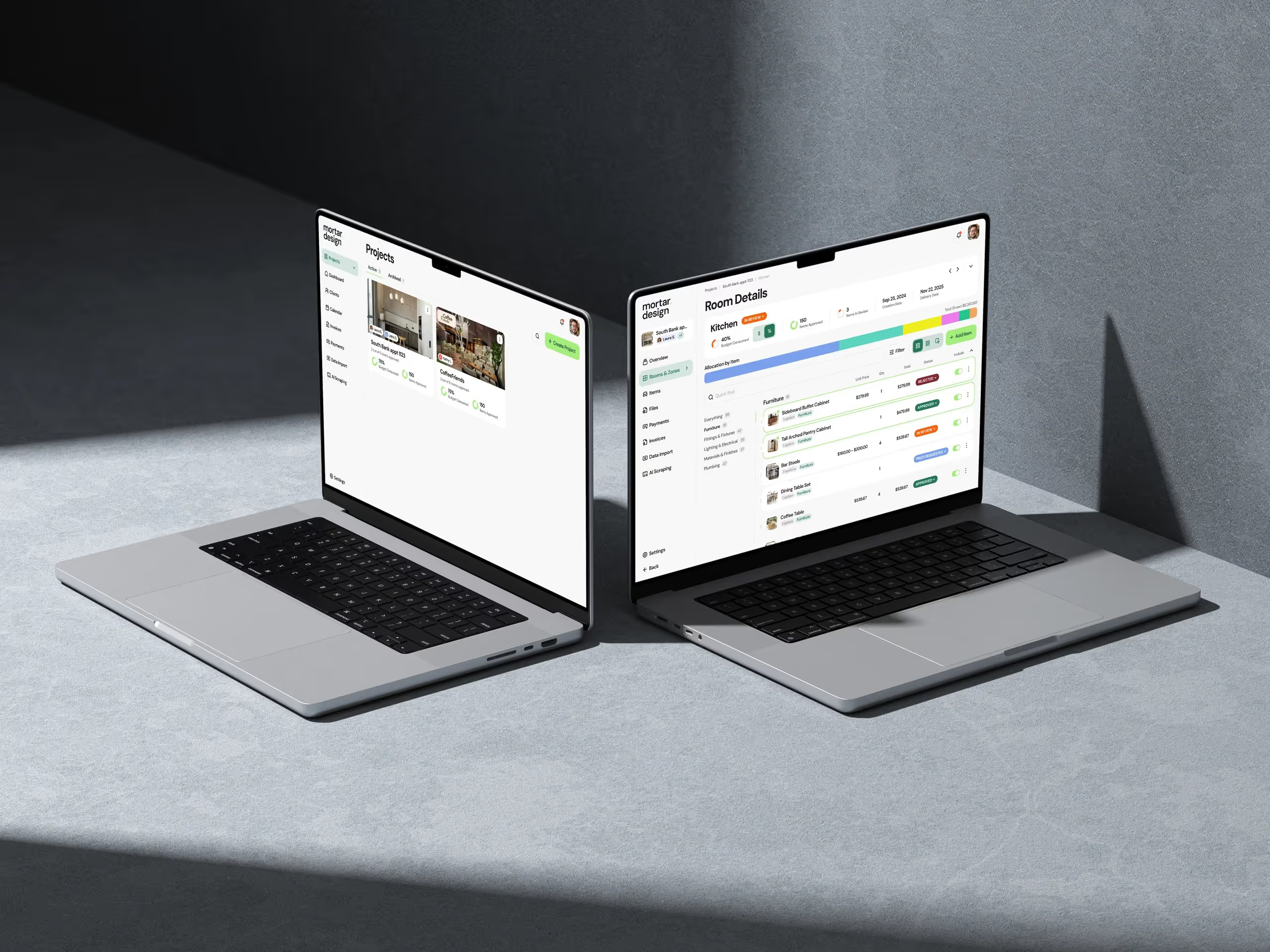

We run Arbeo, our applicant tracking system, as one engine with separate entry points for each industry. The first is First Shift, for independent home care agencies in the US. What changes per niche is the brand, the role templates, the credentials an application collects and the screening rules. The pipeline, the AI that reads applications, the automations and the safeguards around them stay shared, so every niche gets every improvement.
The problem with "an ATS for everyone"
Arbeo started as an applicant tracking system for small businesses that don't want the complexity of an enterprise ATS. That's still what it is at app.arbeo.jobs.
The trouble with "for small businesses" is that nobody searches for it, and nobody recognises themselves in it. A home care agency owner hiring caregivers doesn't think of themselves as a small business looking for an ATS. They think of themselves as someone who needs caregivers with current CPR, a clean registry check and a car, who can start next week.
So the question became: do we build a separate product for each industry, or one product that adapts? We chose one product. It has to be good enough at the general job, with niche sites as the way in.
What an entry point is
An entry point is its own website, its own brand and its own story for one industry, sitting on top of the same ATS.
For US home care, that's First Shift, which went live in September 2026. An agency owner finds First Shift, reads about hiring caregivers, and signs up. Underneath, they're using Arbeo. Their candidates see the agency's name and First Shift, not a generic tool.
We frame it internally as "Arbeo, now for home care, via First Shift". More entry points will follow, each one picked on its own research rather than guessed at.
What changes per niche
Brand
Candidate-facing pages and emails carry the niche brand. A caregiver applying to a home care agency sees that agency's name and First Shift, not Arbeo. The niche site does the marketing, with content, free tools and comparison pages written for that industry. First Shift has a free caregiver interview scorecard, for example. A generic ATS site would never think to write it.
Role templates
A home care agency hires for a short list of roles, again and again. So First Shift comes with role templates built for caregivers. Each template sets up the application form with the fields that role actually needs, rather than starting from a blank job.
That's a big part of what makes a niche product feel like it was built for you. The first job you post already looks like your job.
Credentials as structured data
In home care, credentials decide whether someone can work, so they can't be left buried in a CV. First Shift collects them as proper fields on the application: things like a state registry number, CPR expiry, a driver's licence with an insured vehicle, and availability across days, nights, weekends and live-in shifts.
One detail matters a lot here. "Not stated" is its own state. A candidate who hasn't mentioned their CPR isn't marked as failing. They're marked as not having said yet, which is a question for the interview, not a rejection.
Screening rules the agency controls
Each niche has its own red flags. For caregivers, that might be a missing registry check or an expired CPR certificate. First Shift ships with screening rules as defaults on the role templates, and the agency can switch each one on or off per job.
Timing is part of the rules too. Home care hiring includes confirming applicants are 18 or over, and health screening that's only tracked after an offer is made. The order things happen in is part of what we built for the niche, not something each agency has to configure.
Language and locale
First Shift is for US agencies, so it speaks US English, with US date formats and each agency's own timezone. Small, but noticeable when it's wrong.
What stays shared
Here's what every Arbeo customer gets, whichever door they came in through.
| Shared across every niche | What it does |
|---|---|
| Pipeline | A visual board of candidates by status, with notes that show on the card |
| AI chat application | Candidates can apply by chatting. It asks for a CV first and only asks about what's missing |
| Fit scoring | A match score broken down by where the evidence came from, so it's never one unexplained number |
| Natural-language search | Type what you're after in plain words instead of building filters |
| Email templates and automations | Bulk emails with a preview of who's getting them, and opt-in status-change emails |
| AI connector | Ask Claude or ChatGPT about your pipeline, read-only |
Every improvement here lands in every niche at once. When we made status-change automations wait 24 hours by default, with moving the candidate back acting as an undo, every entry point got that. When we cut the AI cost per application by using a smaller model where it's good enough and summarising the conversation as it goes instead of re-reading all of it, every entry point got cheaper to run. That matters when you're charging small agencies small money.
That's the economic case for one engine. A separate product per niche would mean building every improvement several times, or more likely, letting the smaller niches fall behind.
How we handle AI in hiring
Hiring decisions affect people's livelihoods, and AI that reads job applications has to be handled carefully. These choices are shared by every niche, and none of them are optional extras.
Candidates are told. Candidates are told when AI is involved in their application.
Agencies can switch it off. AI screening can be turned off per job. Some roles, or some agencies, don't want it, and that's their call.
No inferences about protected attributes. Every prompt is explicitly told not to infer anything about protected attributes. Recruiters can't search on protected-class terms at all.
The score only looks at what the job needs. The match score is built from the must-haves the agency sets for the role, not a general judgement of the person.
Data doesn't hang around. Each agency sets its own data retention, and old candidate data is cleared automatically.
People decide. The score is there to help a recruiter decide who to talk to first. The decision stays with them. Our AI connector for Claude and ChatGPT is read-only on purpose: it can rank and compare, but it can't change a status, add a note or contact anyone.
Some things we choose not to build. We could have added AI voice interviews to the first step of an application. Technically, it's not hard. But someone applying for a job probably isn't ready to be interviewed by an agent, and it's a lot less personal. A person should interview a person. If we ever add voice, it'll be something an agency switches on, not the default.
We'd rather describe exactly what the product does than make broad claims about it. Each agency is still responsible for its own hiring process, and we build the product to make good practice the easy path.
What we'd tell a founder thinking about this model
The one-engine, many-entry-points model isn't right for everything. It works when three things are true.
- The core job is genuinely the same. Posting a job, collecting applications, moving people through a pipeline and talking to them is the same work in home care as in retail. If the core job differs, you need different products.
- The differences fit in configuration and content. Role templates, credential fields, screening rules and a brand are things one engine can carry. A completely different workflow isn't.
- The niche needs its own front door. People search for their industry's problem, not your category. A niche validation step matters more here than anywhere, because each new entry point is a bet on one audience.
There's also a newer reason this model works. With AI in the product, a lot of what used to need custom code per industry is now prompts, templates and rules. The line between vertical AI and vertical SaaS is blurring, and a shared engine with niche configuration is one practical way to build on that.
More on the product at Arbeo, and on the home care entry point at First Shift.
FAQ
What is a niche entry point for a SaaS product?
It's a separate website and brand aimed at one industry, sitting on top of a shared product. For Arbeo, First Shift is the entry point for US home care agencies. Customers get industry-specific templates and rules, on the same engine as everyone else.
What changes in Arbeo for each industry?
The brand candidates see, the role templates, the credentials the application collects, the screening rules and the language and locale. The pipeline, AI application, scoring, search, automations and AI safeguards are shared.
Does First Shift use AI to make hiring decisions?
No. AI helps read applications and suggests who to talk to first, but the decision stays with the recruiter. Candidates are told when AI is involved, and agencies can switch AI screening off per job.
Why not build a separate product for each industry?
Because every improvement would have to be built several times, and the smaller niches would fall behind. One engine means every entry point gets every improvement, and the cost of running it stays low enough for small businesses.
If you're weighing up a vertical product, or a niche version of an existing one, here's how we work.
 Consulting Inquiries