I've been building software for 25 years, and here's what I've learned: the best products sell themselves. Not through clever marketing copy or aggressive sales tactics, but because they solve real problems so well that users can't imagine working without them.
This article is part of our complete go-to-market strategy guide.

That's the promise of product-led growth (PLG). But here's the thing — everyone talks about PLG like it's some magical formula. Just make your product free, add a viral loop, and watch the money roll in. If only it were that simple.
At Dazlab.digital, we've built PLG strategies for vertical SaaS products across industries. Some worked brilliantly. Others crashed and burned. The difference? Understanding that PLG isn't a one-size-fits-all playbook. It's a fundamental shift in how you think about building and selling software.
Why Traditional GTM Strategies Are Breaking Down
The old playbook went something like this: build product, hire sales team, pound the phones. It worked when software buyers had time for demos and budget for six-figure contracts. But that world is disappearing fast.
Today's software buyers — whether they're HR managers evaluating recruiting tools or interior designers looking for project management software — expect to try before they buy. They don't want to sit through an hour-long demo to find out if your product actually solves their problem. They want to sign up, click around, and know within minutes if it's worth their time.
This shift isn't just about buyer preferences. It's about economics. The cost of acquiring customers through traditional sales motions has skyrocketed. Meanwhile, the willingness to pay for software has fragmented. You've got enterprises still writing big checks, but you've also got thousands of small businesses who need solutions but can only afford $50-500/month.
Traditional sales-led growth can't scale down to serve these customers profitably. The math simply doesn't work. You can't have a sales rep spending hours to close a $100/month deal. But with PLG, you can serve both segments — letting small customers self-serve while your sales team focuses on expansion and enterprise deals.
The Real Components of Product-Led Growth
Let's get specific about what actually makes PLG work. It's not just about having a free trial. I've seen plenty of products with free trials that still struggle to grow. Real PLG requires fundamental changes to how you build and position your product.
Time-to-Value is Everything
When we built a billing management tool for creative agencies, our first version required users to set up their entire client roster, configure tax rates, and customize invoice templates before they could send their first invoice. We thought we were being helpful by making everything customizable. Users thought we were wasting their time.

The lesson? Every step between signup and value realization is a chance for users to give up. Your job is to compress that journey as much as possible. Ask yourself: what's the absolute minimum a user needs to do to experience the core value of your product? Start there.
Product as the Primary Growth Channel
In traditional GTM, marketing brings leads and sales closes them. In PLG, the product itself becomes your primary growth channel. This happens through several mechanisms that need to be deliberately designed into your product.

Network effects are the holy grail — think about how Slack grows within organizations. One team starts using it, invites another team to collaborate, and suddenly it's spreading across the entire company. But network effects are rare and hard to manufacture.
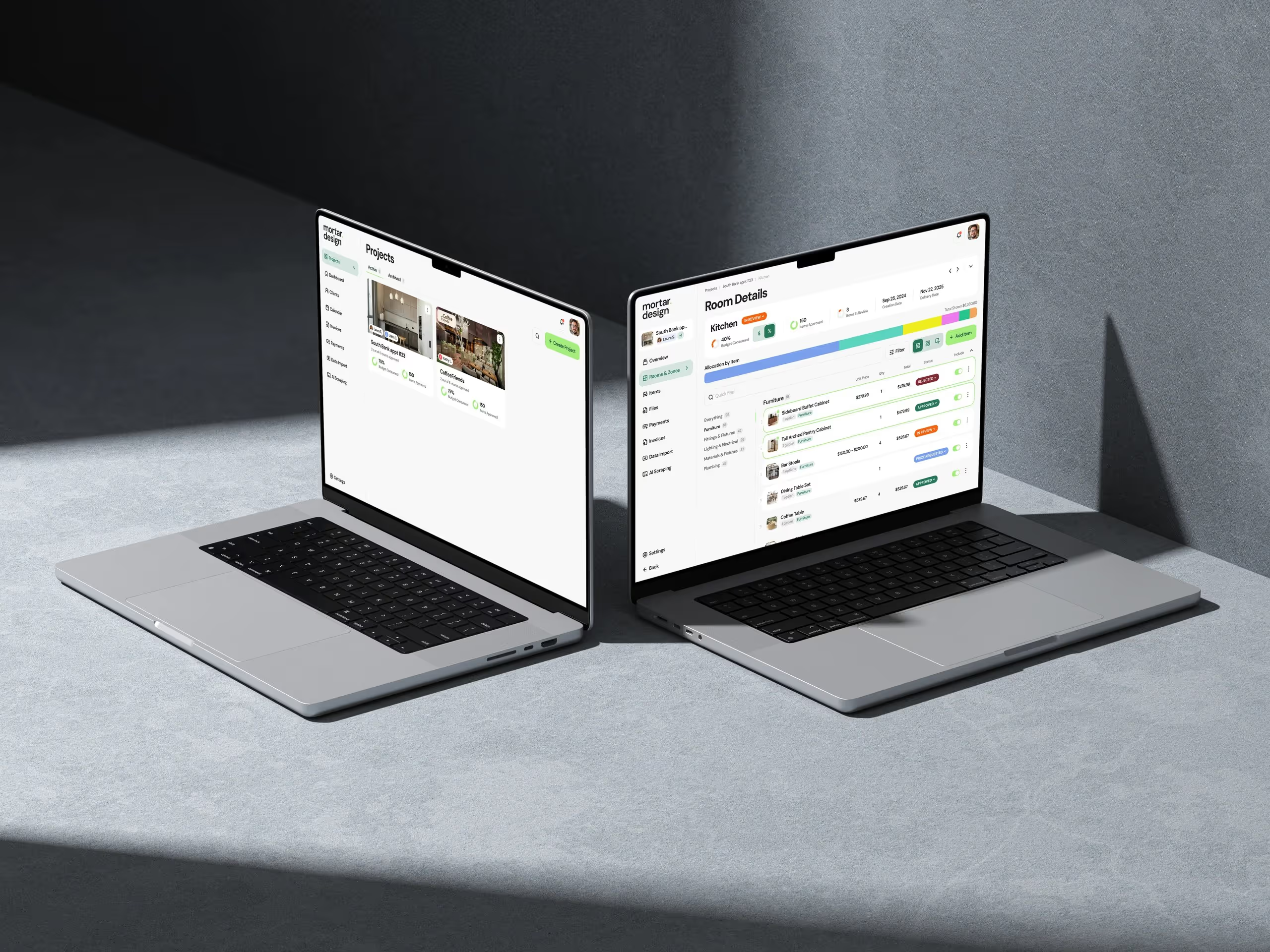
More achievable is what I call "workflow virality." When someone uses your product to collaborate with others, those others naturally get exposed to your product. We built this into a project management tool for interior designers. When designers shared mood boards with clients or contractors, those stakeholders experienced the product firsthand. About 15% of those exposed users ended up creating their own accounts.
Even simple sharing mechanisms can drive growth. But here's the key — the sharing has to feel natural, not forced. Nobody wants to spam their colleagues just to get a discount. The viral mechanism should make the user's life easier while simultaneously exposing new users to your product.
Self-Service That Actually Works
Self-service in PLG isn't just about letting users sign up without talking to sales. It's about building an experience so intuitive that users don't need to talk to anyone. This is harder than it sounds, especially for complex B2B products.
We learned this the hard way with an HR tech product. We had comprehensive documentation, video tutorials, even an AI chatbot. Usage data showed that users still got stuck at the same points. The problem wasn't lack of information — it was that our product flow didn't match how HR managers actually thought about their recruiting process.

Good self-service starts with understanding your users' mental models. How do they currently solve this problem? What terminology do they use? What are their existing workflows? Your product should feel like a natural extension of how they already work, not force them to learn an entirely new paradigm.
Interactive onboarding beats documentation every time. Instead of telling users how to set up their first recruiting pipeline, we built a guided flow that walked them through it step by step. Completion rates for initial setup jumped from 23% to 78%. The product taught users how to use it by having them actually use it.
Building Your PLG GTM Strategy
Now let's talk about how to actually build a product-led growth strategy SaaS companies can implement. This isn't about copying what worked for Slack or Zoom. It's about finding the right PLG approach for your specific market and product.
Start with Product-Market Fit (But Not How You Think)
Everyone says you need product-market fit before pursuing PLG. That's true, but incomplete. You need a specific type of product-market fit — one where users can discover that fit on their own, without hand-holding.
Traditional product-market fit might mean your product solves a problem well when properly implemented with training and customization. PLG product-market fit means your product solves a problem well right out of the box, with minimal setup.
We made this distinction when building a content management system for real estate associations. The first version required significant customization to match each association's needs. It sold well through our consulting channel but failed as a self-service product. We rebuilt it with smart templates for common association types. Now associations could get 80% of what they needed immediately, with customization as an optional layer.
Design Your Pricing for Expansion
PLG pricing isn't just about having a free tier. It's about creating a natural expansion path that aligns with customer value. Too many SaaS products treat pricing as an afterthought, then wonder why their free users never convert.
The best PLG pricing strategies share a few characteristics. First, they align with value metrics that naturally grow as customers succeed. If you're building project management software for agencies, pricing by number of active projects makes more sense than per-seat pricing. As agencies grow and take on more projects, your revenue grows automatically.
Second, they remove friction from the upgrade process. Nothing kills PLG momentum faster than forcing users to talk to sales when they hit a usage limit. Make upgrading as simple as entering a credit card. Save the sales conversations for strategic expansion discussions.
Third, they provide clear value at each tier. Free users should get enough value to solve real problems. Paid tiers should offer capabilities that users genuinely need as they scale, not arbitrary feature gates designed to force upgrades.
Implement Product Analytics That Matter
You can't improve what you don't measure. But in PLG, you need different metrics than traditional SaaS. Monthly recurring revenue (MRR) still matters, but it's a lagging indicator. By the time MRR drops, you've already lost the customer.
Focus on leading indicators that predict revenue. What actions correlate with long-term retention? For our interior design software, we found that users who created their third project within the first week had 85% higher six-month retention. That insight changed our entire onboarding strategy.
Track the full user journey from signup to expansion. Where do users drop off? Which features drive upgrades? What behaviors predict churn? Modern product analytics tools make this easier than ever, but you need to know what questions to ask.
Don't just track averages — segment ruthlessly. PLG attracts diverse users with different needs. A freelance designer uses your product differently than an agency owner. Understanding these segments helps you optimize the experience for each one.
Common PLG Pitfalls (And How to Avoid Them)
I've seen smart teams make the same PLG mistakes repeatedly. Here are the big ones and how to sidestep them.
The Free User Trap
"We have 10,000 free users!" Great. How many are actually engaged? How many could realistically convert to paid? Too many PLG products optimize for signup volume without thinking about quality.
Free tiers should attract potential customers, not freeloaders. We learned this with our billing software. Our initial free tier was too generous — users could run their entire business without upgrading. We shifted to a usage-based limit that let users experience the product fully but naturally led to upgrades as their business grew.
The key is finding the right balance. Too restrictive and users can't experience enough value to convert. Too generous and they have no reason to upgrade. Test different limits and watch both signup rates and conversion rates. You want both to be healthy.
Ignoring the Enterprise
PLG doesn't mean abandoning enterprise sales. In fact, the best PLG companies use product-led growth to feed their enterprise motion. Individual users or teams adopt the product, prove value, then expand to the broader organization.
But this requires deliberate design. Enterprise buyers have different needs — security requirements, admin controls, integration capabilities. If you wait until you have enterprise interest to build these features, you'll lose deals to competitors who planned ahead.
We've found success with a hybrid approach. Let the product lead for initial adoption and small team expansion. Then layer in sales assistance for organization-wide rollouts and strategic accounts. The product does the hard work of proving value; sales helps navigate procurement and change management.
Neglecting Customer Success
Just because users can self-serve doesn't mean they should be left entirely on their own. PLG customer success looks different than traditional models, but it's equally important.
Instead of high-touch onboarding calls, invest in scalable education. We've seen great results from targeted email campaigns based on user behavior. If someone creates their first project but doesn't invite team members, send them a guide on collaboration features. If they're approaching usage limits, proactively share tips on managing their plan.
In-app messaging can guide users at critical moments without human intervention. But make it smart — nobody wants to see the same tooltip fifty times. Use behavioral triggers to show the right message at the right time to the right user.
Making PLG Work for Your Vertical SaaS
PLG gets harder when you're building for specific verticals. Interior designers have different workflows than HR managers. Real estate associations operate differently than digital agencies. Can PLG work for these specialized markets?
Absolutely. In fact, vertical SaaS products can have PLG advantages that horizontal tools lack. You can make stronger assumptions about user needs. You can use industry-specific terminology that resonates immediately. You can build workflows that match exactly how your users already work.
The key is reducing the abstraction layer. Generic project management tools require users to figure out how to adapt the tool to their workflow. Vertical solutions can provide that adaptation out of the box. When we built project management specifically for interior designers, we didn't make them figure out how to use "tasks" and "milestones" for their process. We gave them "design phases" and "client approvals" — concepts they already understood.
This specificity accelerates time-to-value. Users don't need to configure the system to match their needs; it already does. They don't need training on industry best practices; those are built into the product. This is PLG GTM at its best — the product itself embodies the go-to-market motion.
From Theory to Practice: Your PLG Roadmap
So how do you actually implement this? Here's the roadmap we use with our consulting clients at Dazlab.digital when building PLG strategies.
First, audit your current user journey. Sign up for your own product with fresh eyes. Time how long it takes to reach that first moment of value. Document every point of friction. Be honest — would you continue using this product if you weren't already invested in it?

Then start small. You don't need to rebuild everything at once. Pick one part of the journey — maybe it's simplifying onboarding or adding a free trial. Test it with a subset of users. Measure the impact. Iterate based on what you learn.
Remember that PLG is a marathon, not a sprint. It took Slack years to perfect their PLG motion. You won't nail it in the first quarter. But each improvement compounds. A better onboarding flow leads to higher activation. Higher activation leads to more upgrades. More upgrades provide revenue to invest in further improvements.
The teams that succeed with PLG share one trait: they're obsessed with user experience. Not in a superficial "make it pretty" way, but in a deep "understand and remove every point of friction" way. They treat every support ticket as product feedback. They watch session recordings to see where users struggle. They talk to users constantly — not in formal research sessions, but in quick, tactical conversations about specific features.
Building a successful product-led growth strategy SaaS companies can scale requires this obsession. It's not enough to add a free trial and call it PLG. You need to fundamentally rethink how your product creates and delivers value. But when you get it right, the results speak for themselves — sustainable growth driven by happy users rather than aggressive sales tactics.
Ready to explore PLG for your vertical SaaS? We've been down this road with products across industries. Let's talk about what could work for your specific market and users. Because at the end of the day, the best GTM strategy is the one that fits your product, your market, and your vision for growth.
Frequently Asked Questions
What's the minimum viable product needed to implement PLG successfully?
Your product needs to deliver its core value within minutes, not hours or days. This means having an onboarding flow that gets users to their first "aha" moment quickly, self-service signup without sales friction, and enough functionality in your free tier for users to solve real problems. We've found that products achieving time-to-value under five minutes see 3-4x higher activation rates.
How do you balance free tier generosity with driving paid conversions?
The key is aligning your limits with natural usage growth. Your free tier should let users fully experience your product's value but hit limitations as their needs expand. For example, our billing software allows unlimited invoices for up to 3 clients — enough to test thoroughly but naturally requiring upgrades as agencies grow. Watch both signup rates and conversion rates when adjusting limits.
Can PLG work for complex B2B vertical SaaS products?
Yes, but it requires building domain expertise directly into the product. Instead of generic features that users must configure, provide industry-specific templates, workflows, and terminology out of the box. Our interior design project management tool uses "design phases" instead of generic "milestones" — this specificity actually makes PLG easier because users immediately understand the value.
What metrics should you track for PLG beyond traditional SaaS KPIs?
Focus on leading indicators that predict revenue: activation rate (users who reach first value), feature adoption rates, and expansion triggers. Track the full journey from signup to expansion, segmented by user type. For our interior design software, users creating three projects in week one showed 85% higher retention — this insight reshaped our entire onboarding strategy.
How do you add enterprise sales to a PLG motion without disrupting it?
Use PLG to feed your enterprise pipeline rather than replace it. Let individuals and teams adopt through self-service, then layer in sales support for organization-wide rollouts. Build enterprise features (SSO, admin controls, advanced security) early so you're ready when PLG users want to expand. The product proves value; sales helps navigate procurement and implementation.
Related Reading

Dazlab is a Product Studio_
Our products come first. Consulting comes second. Whichever path you take, you’ll see how a small team can deliver outsized results.