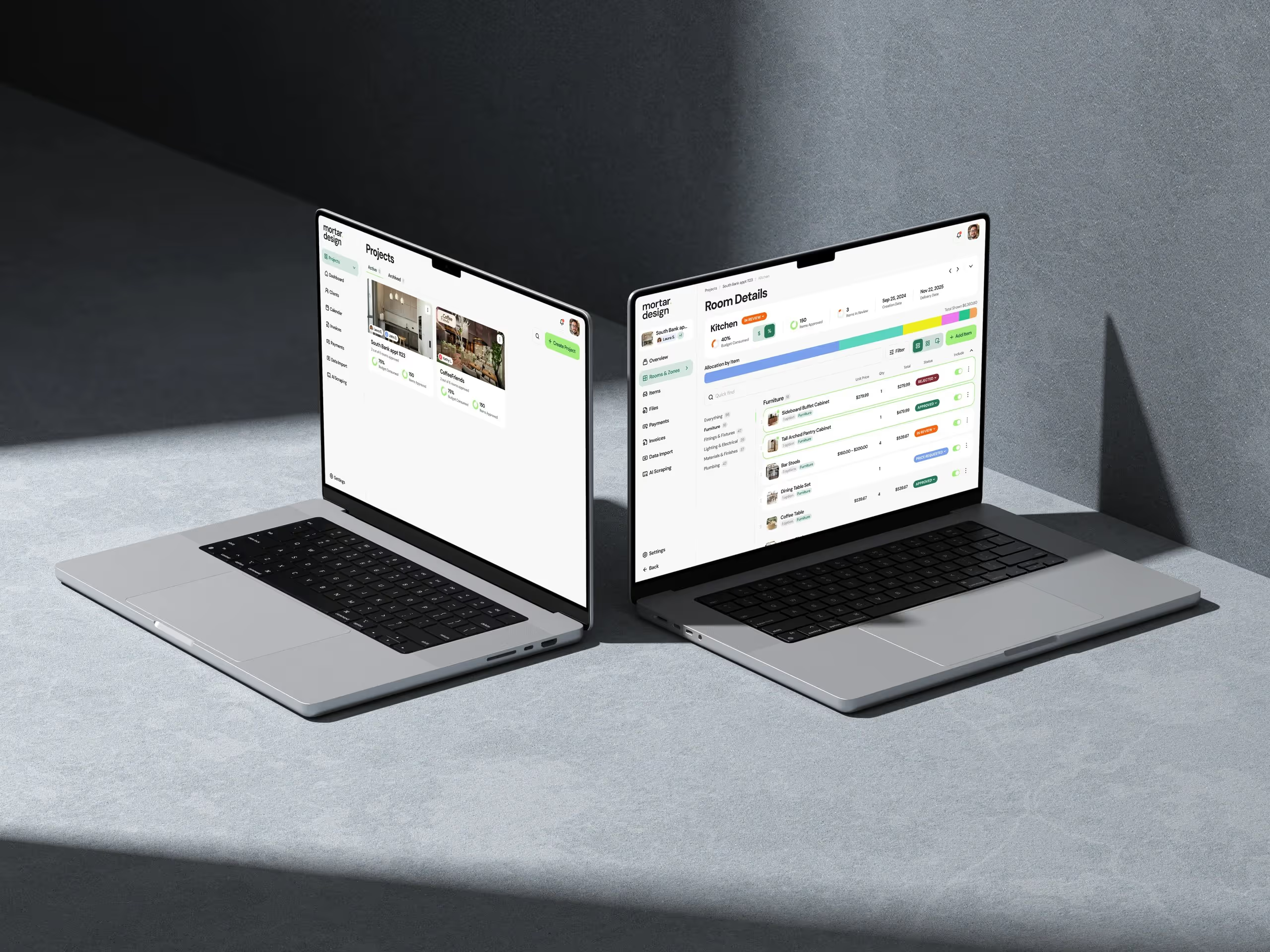

I've been building software for 25 years, and I can tell you this: the AI gold rush has created a problem. Everyone's adding AI features to their products. LLM-powered chat here, predictive analytics there, maybe some automated workflows thrown in for good measure. But here's what I'm seeing—most of it doesn't create actual competitive advantage.

The difference between slapping AI onto your product and building genuine competitive advantage AI innovation comes down to one thing: finding opportunities where AI solves a problem that's unique to your market, your customers, and your position in the ecosystem. Not the problems everyone else is solving.
Let me show you how to identify those opportunities. This isn't theory—it's what we've learned building vertical SaaS and AI-native products for clients who needed to differentiate or die.
Why Most AI Innovation Doesn't Create Competitive Advantage
Walk into any SaaS product today and you'll find the same AI features. A chatbot. Some email automation. Maybe a dashboard that uses ML to predict churn. These are table stakes now, not differentiators.
The problem is that most teams approach AI innovation backwards. They start with "what cool AI thing can we build?" instead of "what unique problem can we solve that others can't?"
I worked with an HR tech company last year that wanted to add AI. Their initial plan? A resume parser and an AI chatbot for candidate questions. Fine features, but their three biggest competitors already had them. No competitive advantage there.
We dug deeper. Turns out, their customers—recruiters at small healthcare practices—struggled with something specific: verifying certifications and licenses that varied by state and specialty. Their competitors served larger enterprises that had compliance teams for this. This was a niche pain point.

That's competitive advantage AI innovation. It's solving a problem that's unique to your position in the market.
The Three Sources of Unique AI Innovation Opportunities
After working on dozens of AI implementations, I've found that genuine competitive advantage comes from three sources. You need at least one of these to build something defensible.

Your Proprietary Data
The most obvious source is data you have that others don't. But here's the nuance—it's not just about having data. It's about having data that's specific enough, labeled well enough, and relevant enough to train models that solve real problems.
I've seen companies with massive datasets that were useless for AI because the data wasn't tagged, contextualized, or structured properly. And I've seen companies with relatively small datasets create huge advantages because they captured the right information.
One of our clients in the interior design space had been collecting project photos and material specifications for years. They didn't think it was particularly valuable until we realized they could train a model to estimate project costs based on room photos and client style preferences. Their data included the actual material costs, labor hours, and vendor pricing—the outcome data that made predictions accurate.
Their competitors had photos, sure. But they didn't have the outcome data linked to those photos. That connection is what created the moat.
Questions to ask about your data:
- Do we capture outcome data that shows what actually happened, not just what we predicted?
- Is our data specific to a niche that others don't serve as deeply?
- Have we been collecting data longer than competitors, giving us historical depth?
- Do we have data from multiple stages of a process that others only see part of?
Your Domain Expertise and Workflows
The second source is understanding workflows and edge cases that only come from deep domain expertise. AI isn't magic—it needs to be guided by people who know what "good" looks like in a specific domain.
We built an AI-powered content management system for a client who managed real estate association websites. The AI could suggest content structures, auto-categorize member resources, and even draft certain types of standardized content.
But the real value wasn't in the AI itself. It was that we encoded years of their expertise about how real estate associations organize information, what compliance requirements they face, and what workflow patterns actually work for their small administrative teams.
A generic AI writing tool or CMS could never replicate that. The domain knowledge was the moat, and AI was just the tool that let us scale that knowledge.
This is especially powerful in vertical SaaS, which is where we focus most of our work. When you deeply understand a specific industry, you can build AI that operates with context and constraints that general-purpose tools can't match.
Your Integration and Ecosystem Position
The third source is your position in your customers' tech stack and the integrations you've built. AI that sits at the intersection of multiple data sources creates value that single-purpose tools can't.
Think about billing software that integrates with project management tools, time tracking, and client communication platforms. An AI that can predict payment disputes based on patterns across all those data sources has a huge advantage over one that only sees the invoice data.
Or consider a project management tool used by agencies. If it integrates deeply with design tools, client feedback platforms, and resource scheduling systems, an AI can optimize timelines and resource allocation in ways that account for the full picture of how work actually flows.
The competitive advantage here isn't just the AI algorithm. It's the data access that comes from being embedded in your customers' workflows.
How to Identify Your Unique Innovation Opportunities
Okay, so you understand the sources of advantage. How do you actually find the opportunities? Here's the process I use, refined over probably fifty discovery workshops with clients.

Map Your Unique Data Assets
Start by making a list of every type of data you collect that isn't generic. Don't just think about obvious stuff like customer records. Think about:
- Data you collect as a byproduct of your service delivery
- Outcome data that shows what worked and what didn't
- Behavioral data about how users actually use your product (not just analytics, but domain-specific actions)
- Third-party data you've licensed or aggregated
- Historical data you've accumulated over time
Then ask: which of these data assets is genuinely unique to us? Which would be hard for a competitor to replicate?
Be honest here. "We have customer data" isn't unique. "We have ten years of before-and-after project photos with actual cost data and client satisfaction scores" might be.
Interview Your Power Users About Hidden Pain Points
Your power users know where the pain is. But they often don't articulate it well, and it's rarely the pain points they mention first.
I do these interviews in a specific way. I ask them to walk me through their actual workflow—not the ideal workflow, but what they actually did yesterday. I want to hear about the workarounds, the manual steps they don't even think about anymore because they're so habitual.
One client's users kept mentioning they wanted "better reporting." Okay, fine, but what does that mean? When we dug into their actual workflow, we found they were exporting data to Excel, running a bunch of formulas, then copying the results into PowerPoint for client presentations.
The pain wasn't reporting. It was that they needed to present data in a very specific format that told a story their clients would understand, and that format varied by client type. We built an AI that learned each client's preferred reporting format and automatically generated those presentations.
That's a unique innovation opportunity—solving a pain point that's specific to how your users work with your product in their specific context.
Look for Workflow Bottlenecks That Require Expertise
Find the places in your users' workflows where they need expertise or judgment that's in short supply. These are goldmines for competitive advantage AI innovation.
In our AI-native product work, we're constantly looking for these moments. They're often invisible to outsiders but obvious once you know the domain.
For example, in HR tech, there's a moment when a recruiter has to decide which candidates are worth phone screening. That requires judgment about culture fit, role requirements, and reading between the lines of a resume. Most ATS systems don't help with this—they just show you a list of applicants.
But if you understand recruiting workflows deeply, you know that this decision point is where recruiters at small companies (who don't have specialized sourcers) waste enormous time. An AI that could reliably make this first-pass judgment, trained on your specific customers' hiring patterns, would be incredibly valuable.
The key is that this AI wouldn't work as a general-purpose tool. It needs to understand the specific types of roles your customers hire for, the specific signals that matter in their industry, and the specific constraints they operate under.
Analyze Competitor Blind Spots
Your competitors are probably adding AI too. But they have blind spots based on their market position, their customer base, and their product architecture.
Make a list of what AI features your competitors are building. Then ask: what customer segments or use cases are they ignoring? What assumptions are they making that might not be true for your customers?
Large enterprise-focused competitors often ignore the needs of smaller customers. They build AI that requires clean data, dedicated IT resources, and complex setup. If your customers are small businesses, there's your opportunity—build AI that works with messy data and requires zero configuration.
Conversely, if your competitors are building for SMBs, they might be ignoring complex compliance requirements or integration needs that enterprises have. That's your opportunity.
Testing Innovation Opportunities Before You Build
Here's where most teams waste money. They identify an opportunity, get excited, and immediately start building. Six months later, they've built something nobody uses.
We learned this the hard way. Now we test every innovation opportunity before writing production code.
The Wizard of Oz Test
For most AI features, you can fake the output manually before you build the model. We call this the Wizard of Oz test—the user thinks they're interacting with AI, but it's actually a human behind the curtain.
When we wanted to test that credential verification system for the HR tech client, we didn't build the AI first. We had a person manually verify credentials for a subset of users for two weeks. We tracked how often they used it, how it changed their workflow, and whether they'd pay for it.
Only after we confirmed they loved it did we invest in building the actual AI system.
The Data Quality Check
Before you commit to building an AI feature, verify you have enough quality data to train it. This seems obvious, but I've seen teams discover six months into development that their data isn't actually usable.
Do a data audit. Pull a sample and manually label it the way your AI would need to. If that's painful or ambiguous, your AI will struggle too.
The Replication Test
This is the real test of whether you have a genuine competitive advantage: could a competitor with more resources replicate your AI feature in six months if they wanted to?
If the answer is yes, you probably don't have a strong moat. You might still want to build it for other reasons—first-mover advantage, bundling value, customer satisfaction. But don't kid yourself that it's a lasting competitive advantage.
If the answer is no—because you have proprietary data they can't access, domain expertise they'd take years to build, or integration depth that requires customer trust—then you've found something worth investing in.
Building Your Innovation Roadmap
Once you've identified opportunities and validated them, you need to prioritize. We use a simple framework with three factors:
Defensibility: How hard would this be for competitors to copy? Score it 1-10.
Value: How much would customers pay for this, or how much would it increase retention? Score it 1-10.
Feasibility: Can we actually build this with our current data and resources? Score it 1-10.
Multiply the scores. Anything above 400 (out of 1000) is probably worth building. Anything below 200 should be deprioritized.
This framework has saved us from building dozens of AI features that seemed cool but didn't actually create competitive advantage.
For more on implementing these ideas into a structured approach, check out our AI Product Innovation Framework guide, which walks through the full process from ideation to launch.
Making Innovation Sustainable
Here's the thing nobody tells you about competitive advantage AI innovation: it's not a one-time thing. The moat you build today can disappear in a year if you're not continuously deepening it.

First, they continuously improve their data collection. Every new feature is an opportunity to capture new signals that make their AI smarter. They think about data as a compounding asset.
Second, they stay close to their users' evolving workflows. As industries change, new pain points emerge. The credential verification system we built is valuable today, but in three years, there might be a new compliance requirement that creates a new opportunity.
Third, they don't let their AI become a black box. They maintain the domain expertise that guided the AI's development. When the AI makes mistakes—and it will—they understand why and can improve it.
Conclusion
Competitive advantage through AI innovation isn't about having the most advanced algorithms or the biggest AI team. It's about finding opportunities where your unique position—your data, your domain expertise, your ecosystem integrations—lets you solve problems that others can't.
The opportunities are there. In every vertical SaaS market, every niche B2B tool, every workflow software, there are pain points that only emerge when you deeply understand the domain. The companies that win won't be the ones with the best AI—they'll be the ones who use AI to deliver value that's impossible to replicate.
We've built our practice around this principle. When clients come to us wanting to add AI to their product, the first question we ask isn't "what AI should we build?" It's "what unique advantages do you have that AI could amplify?" That shift in perspective makes all the difference.
If you're thinking about how AI could create competitive advantage for your product, start with those three sources: your data, your expertise, and your position in your customers' workflows. Find the intersection of those three, and you'll find opportunities that are worth building.


Dazlab is a Product Studio_
Our products come first. Consulting comes second. Whichever path you take, you’ll see how a small team can deliver outsized results.