I've built enough SaaS products to know that most "personalization" is just glorified if-then statements. Show a different homepage hero based on industry. Maybe swap out a few dashboard widgets based on role. Call it "personalized" and ship it.

Real AI personalization engines are different. They actually learn from user behavior, adapt in real-time, and get smarter the more people use your product. I'm talking about systems that can predict what a user needs before they search for it, surfaces the right content at exactly the right moment, and fundamentally reshape the product experience for each individual user.
The gap between basic personalization and true AI personalization engines SaaS products can implement is massive. And frankly, most teams are leaving serious competitive advantage on the table by sticking with the former. Let me show you what building real adaptive systems actually looks like.
What Makes an AI Personalization Engine Actually "AI"
Here's the litmus test: if you can diagram the entire decision tree in a flowchart, it's not AI personalization. It's rule-based personalization dressed up with buzzwords.
True AI personalization engines have three characteristics:
- They learn continuously — The system gets better over time as it observes user behavior, without you manually updating rules
- They handle complexity — They can process dozens or hundreds of signals simultaneously to make recommendations
- They discover patterns you didn't program — The engine finds correlations and user segments you never explicitly defined
I worked on a project management SaaS where we replaced rule-based task recommendations with an actual ML-powered engine. The rule-based system had about 15 manually crafted rules: "If user is project manager, show project overview. If user is contributor, show assigned tasks." Pretty standard stuff.
The AI version learned that certain users always checked budget status before looking at tasks on Monday mornings. It surfaced budget widgets first for those users on Mondays. We never programmed that pattern — the engine discovered it by analyzing thousands of user sessions. That's the difference.
The Architecture of Learning: How Personalization Engines Actually Work

Data Collection Layer
You need comprehensive behavioral data. Not just page views — actual interaction patterns. What features do users engage with? How long do they spend on specific tasks? What do they search for? What paths do they take through your product?
Most analytics tools capture some of this, but personalization engines need more granular event streams. We typically instrument products to track:
- Feature usage patterns (which tools they use, in what sequence)
- Content engagement (what they read, download, or bookmark)
- Workflow patterns (how they complete common tasks)
- Temporal patterns (time of day, day of week behaviors)
- Context signals (company size, industry, role, team composition)
The key is capturing this data without destroying your database performance. Event streams should feed into a separate analytics pipeline, not clog up your transactional database with tracking inserts.
Learning Layer
This is where the actual intelligence lives. You're building models that can predict user intent and preferences based on behavioral signals.

For SaaS personalization, collaborative filtering works surprisingly well. The core idea: users who behave similarly probably want similar things. If User A and User B have 80% overlap in their feature usage, and User A loves Feature X that User B hasn't discovered yet, there's a good chance User B would benefit from Feature X too.
We've also had success with content-based filtering, especially for surfacing help articles or template recommendations. If a user frequently works with specific data types or workflows, surface content related to those patterns.
The mistake I see teams make is overcomplicating this layer. You don't need a massive neural network for effective personalization. Start with simpler algorithms like matrix factorization or gradient boosted trees. They're easier to debug, faster to train, and honestly work better for most SaaS use cases than deep learning approaches.
Delivery Layer
This is where predictions become actual product experiences. Your personalization engine needs to integrate with your application in real-time.
We typically build this as a microservice that exposes a simple API: "Given this user and this context, what should we show them?" The response comes back in milliseconds with ranked recommendations, personalized content, or adaptive UI configurations.
The delivery layer also handles the feedback loop. When a user interacts with (or ignores) a personalized recommendation, that signal feeds back into the learning layer. This is how the engine gets smarter over time.
Practical Use Cases That Actually Move Metrics
Theory is nice. Let's talk about what AI personalization engines in SaaS actually improve when implemented well.
Adaptive Onboarding That Actually Converts
Standard onboarding flows show every user the same sequence of steps. AI-driven onboarding adapts based on how users are actually engaging.

I built a system for a CRM product that tracked which features new users explored during their first session. If someone immediately jumped to email integrations and skipped contact management, the engine recognized they probably wanted email automation capabilities. The second session, we surfaced email templates and automation workflows instead of forcing them through contact management tutorials they'd already skipped.
This approach cut time-to-value by about 40% because users reached their "aha moment" faster. Activation rates improved by 27% because onboarding felt relevant instead of generic.
Intelligent Feature Discovery
Most SaaS products have features that only 10-20% of users discover. That's wasted development effort and lost value.
Personalization engines can surface underutilized features to users who would actually benefit from them. The key is matching feature capabilities to user workflows.
We implemented this for a design collaboration tool. The product had powerful version control features, but only 15% of users discovered them. The engine identified users who were repeatedly uploading similar file names (design_v1, design_v2, design_final, design_final_ACTUALLY_FINAL) — a clear signal they needed version control but didn't know it existed.
We showed those users contextual prompts about version control at the exact moment they were experiencing the pain. Feature adoption jumped from 15% to 43% within three months.
Predictive Content Surfacing
If you have any kind of content library — help docs, templates, reports, dashboards — AI personalization can dramatically improve how users find what they need.
Instead of relying on search (which requires users to know what to search for), predictive engines surface relevant content based on what the user is currently doing.
I've seen this work particularly well in vertical SaaS products where users follow industry-specific workflows. A property management SaaS we worked with had hundreds of lease templates and legal documents. Instead of making users browse categories, the engine learned which documents were typically needed at different stages of the leasing workflow and surfaced them proactively. Document retrieval time dropped by 60%.
Dynamic UI Adaptation
This is where personalization gets really interesting. The product interface itself adapts to each user's preferences and behavior patterns.
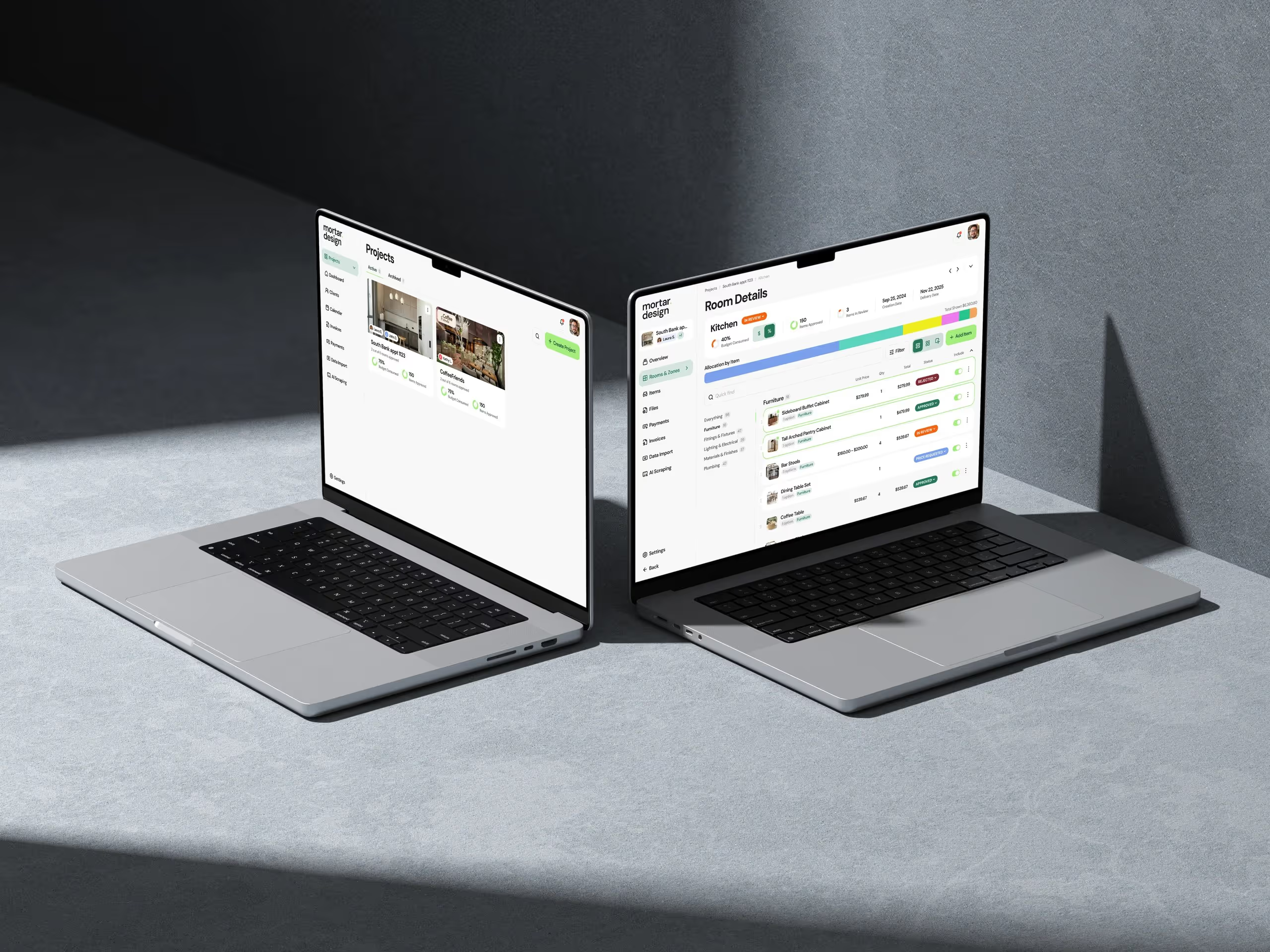
We built a system for a project management tool that learned which widgets each user actually looked at versus which they ignored. Over time, the dashboard automatically reorganized itself to prioritize the information each user cared about most.
Power users who lived in Gantt charts saw those prominently. Managers who only cared about high-level status got executive summaries front and center. Contributors who just needed their task list got exactly that without wading through project-wide views they never used.
The key was making this adaptation gradual and giving users control. Nobody likes waking up to a completely reorganized interface. The changes happened incrementally, and users could always override the AI's decisions.
The Technical Challenges Nobody Warns You About
Building effective AI personalization engines for SaaS products is harder than most articles admit. Here's what actually trips teams up.
The Cold Start Problem
Personalization engines need data to work. But new users have no behavioral history. How do you personalize when you know nothing about someone?
We handle this with a hybrid approach. New users get a sensible default experience based on demographic/firmographic data (role, company size, industry). As soon as they start interacting with the product, the engine begins personalizing based on behavior. Usually within 2-3 sessions, you have enough signal to provide meaningful personalization.
Some teams try to solve cold start with extensive onboarding surveys. "Tell us about your goals and preferences!" This rarely works. People don't know what they want until they use the product. And nobody wants to fill out a 20-question survey before they've seen any value.
Avoiding Filter Bubbles
If your personalization engine only shows users things similar to what they've engaged with before, they never discover new capabilities. You create a filter bubble that actually limits product adoption.
The solution is strategic exploration. We typically allocate 10-15% of personalized recommendations to "discovery" — showing users features or content they haven't seen before, even if the engine isn't confident they'll engage with it.
This serves two purposes. First, users discover more of your product. Second, the engine gathers data about preferences it wouldn't otherwise learn about. Maybe it turns out this user actually loves Feature X but never would have discovered it through pure exploitation of their known preferences.
Performance at Scale
Generating personalized experiences in real-time is computationally expensive. You can't run a complex ML model on every page load for thousands of concurrent users.
The solution is pre-computation and caching. We run the heavy ML models asynchronously, generating personalized recommendations ahead of time and storing them. When a user loads a page, you're just retrieving pre-computed results, not running inference in real-time.
This works well for most SaaS use cases because user behavior doesn't change minute-to-minute. Regenerating personalized recommendations every few hours is usually sufficient. For truly real-time scenarios (like in-app searches), you need lighter-weight models that can run quickly or edge computing architectures that move computation closer to users.
Explainability and Trust
Users need to understand why they're seeing personalized content, especially in B2B SaaS where they're making business decisions based on what your product shows them.
Black box recommendations erode trust. "Our AI thinks you should do X" isn't good enough when X affects someone's business outcomes.
We build explainability into personalization systems from the start. Show users why something is being recommended: "Based on your recent work with Q4 financial reports" or "Teams similar to yours frequently use this feature." This transparency builds trust and actually helps users learn how to get more value from the product.
Building vs. Buying: The Real Economics
Should you build your AI personalization engine from scratch or integrate a third-party solution?
The honest answer: it depends on your product's complexity and differentiation strategy. This is covered more deeply in our AI-Driven Product Innovation and Differentiation for SaaS: The Complete 2026 Guide, but here's the short version.
Third-party personalization platforms make sense when:
- Your product has relatively standard personalization needs (content recommendations, user segmentation)
- You're early stage and need to validate that personalization matters before investing heavily
- You lack ML/AI expertise in-house
Building custom engines makes sense when:
- Personalization is core to your product differentiation
- You have unique domain-specific personalization requirements
- You're handling sensitive data that can't easily be sent to third-party services
- You've validated that personalization drives your key metrics and want to optimize further
I generally recommend starting with simpler, rule-based personalization to validate the concept, then graduating to true AI-powered systems once you've proven the business case. Don't build a sophisticated ML pipeline before you know that personalization actually matters for your users.
The Implementation Roadmap That Works
Here's how we typically roll out AI personalization engines for clients:
Phase 1: Instrumentation (2-4 weeks)
Add comprehensive behavioral tracking across your product. You need at least 4-6 weeks of data before you can train meaningful models. Don't skip this phase — garbage in, garbage out.
Phase 2: Baseline Personalization (4-6 weeks)
Build rule-based personalization for a single high-impact use case. This proves out the delivery infrastructure and UI patterns before adding ML complexity. Pick something like personalized onboarding or dashboard layouts.
Phase 3: ML-Powered Engine (8-12 weeks)
Train your first ML models using the behavioral data you've collected. Start with collaborative filtering for recommendations or content ranking. Deploy to a small percentage of users and validate that the ML approach outperforms rule-based logic.
Phase 4: Expansion (Ongoing)
Gradually expand personalization to more use cases and more users. Add more sophisticated models as you gather more data and learn what drives your metrics.
The key is incremental rollout with clear success metrics at each phase. Don't try to personalize everything at once. Pick the highest-leverage use cases and nail those before expanding.
Measuring What Actually Matters
How do you know if your personalization engine is working?
Forget vanity metrics like "recommendations shown" or "personalization coverage." Focus on business outcomes:
- Activation rate — Do personalized onboarding experiences get more users to their aha moment?
- Feature adoption — Are users discovering and using more of your product?
- Time-to-value — Do users accomplish their goals faster with personalized experiences?
- Retention — Do users with personalized experiences stick around longer?
- Expansion — Do personalized upgrade prompts drive more conversions?
Run controlled experiments comparing personalized experiences to generic ones. Measure the delta in your core metrics. If personalization isn't moving business outcomes, either your implementation is wrong or personalization isn't as valuable for your product as you thought.
The Future of Adaptive SaaS Products
Where is this heading? I see AI personalization engines becoming table stakes for competitive SaaS products over the next 2-3 years.
The next wave will be generative personalization — products that don't just surface existing content or features differently, but actually generate new experiences tailored to each user. Think custom workflows generated on-the-fly, AI-written onboarding content specific to your use case, or interfaces that literally reconfigure themselves based on your work patterns.
We're also seeing more sophisticated cross-session and cross-device personalization. Your SaaS product knowing that you always start work by reviewing dashboards on your desktop in the morning, then switch to your tablet for field work in the afternoon, and adapts the experience accordingly.
The products that win won't be the ones with the most features. They'll be the ones that feel like they were built specifically for each user — because in a sense, they were.
Conclusion: Personalization as Product Strategy
Building true AI personalization engines isn't a nice-to-have feature you bolt on late in your product roadmap. It's a fundamental product strategy that affects everything from your data architecture to your user experience design.
The SaaS products I see winning in their categories right now aren't necessarily the ones with the longest feature lists. They're the ones that feel intuitive and relevant to each individual user. The ones that seem to
Related: building AI-native vertical SaaS
Dazlab is a Product Studio_
Our products come first. Consulting comes second. Whichever path you take, you’ll see how a small team can deliver outsized results.